A Worship Stylesheet

Stylesheet

When preparing worship materials, how you print something is important to communicate what is happening in worship. The suggestions below are based on practices in several modern hymnals and worship books. The rites and prayers on this website follow the principles described below.

Directions or Rubrics

In ancient times, worship books put directions or descriptions in red, which is why they were called rubrics. Even when a book or service folder is printed with only black ink, the use of italics can indicate a direction. Somewhere I read that the slant and added detail in italic type make the eye slow down–ideal for making people pay attention to a direction or description.

Stand

Be seated

Silent prayer

Special prayers or intercessions may be made.

Dialogues

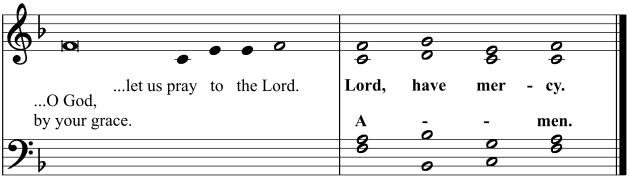
Worship often has dialogues between pastor/leader and people. This can be communicated with regular type for the leader and bold type for the group.

While initials can be used, they take up space, and the page looks more elegant without them. Compare…

Bless the Lord, O my soul.
All that is within me, bless his holy name.

with…

P: Bless the Lord, O my soul.
C: All that is within me, bless his holy name.

Older books often had even more written out:

Minister: Our help is in the name of the Lord.
Congregation: The maker of heaven and earth.

When a congregation sees bold type, people instantly know that it’s their part and that they should read it. No announcement is necessary. My congregation prints out funeral services this way with no indicators for Minister or Congregation (M: or C:) and no special announcement, and the congregation of mostly visitors knows right away that they are supposed to read the parts in bold.

Since dialogues are often in couplets (the group answers the leader) print the dialogue in couplets. It will help show the connections. It also saves some space. Compare this…

The Lord be with you.

And also with you.

Lift up your hearts.

We lift them up to the Lord.

Let us give thanks to the Lord our God.

It is right to give him thanks and praise. 

With this…

The Lord be with you.
And also with you.

Lift up your hearts.
We lift them up to the Lord.

Let us give thanks to the Lord our God.
It is right to give him thanks and praise.

Titles / Section Headings

Since congregation parts are printed in bold, you must be careful when printing titles. Some books use all caps to distinguish titles from text that is intended to be read:

APOSTLES’ CREED

I believe in God the Father almighty, maker of heaven and earth.

In social media, all caps are often interpreted as shouting. Other methods of indicating titles are to use a larger size, or a larger size with a different font. Using corresponding fonts can avoid a clash of styles. Fonts are discussed below.

CreedTitle

Confusing the Typographical Language

It’s tempting to put the Lord’s Prayer or the Twenty-third Psalm in italics because it looks pretty. This should be avoided since it confuses the typographical language. If you establish the habit of using italics for directions, what does it mean when other text is in italics?

“But it looks pretty…”

That leads us to the thought about type styles. There are many artistic fonts available. Some imitate calligraphy, brush lettering, or Gothic lettering from an old book. Use those to make your own cover art with a short Bible passage, hymn stanza or prayer. Standard Roman style fonts are best for readability.

Some recommended fonts are:

  • Times New Roman (Good regular/bold contrast. Very basic. Some might say too basic! Italics are true italics, and more interesting than the regular.)
  • Linux Libertine (Roman-style font with some nice nuances. It is used for headings in Wikipedia. It is made to go with…)
  • Linux Biolinium (A sans-serif font with the same dimensions as Linux Libertine. Thin/thick lines correspond to Libertine.)
  • Merriweather (Similar to Linux Libertine, only it’s about 1.5 points bigger than it says it is. It is made to go with…)
  • Merriweather Sans. (Same font shapes only with uniform lines and no serifs.)
  • PT Serif (Another Roman-style font with nice nuances. It is made to go with…)
  • PT Sans (a corresponding sans version) 
  • Palatino (Palladio and Book Antiqua are clones of Palatino) (Roman-style font with some calligraphic qualities.)
  • Century Schoolbook (for a very old-fashioned look)
  • EB Garamond (Very clear and stately. See the note on The Book of Common Prayer below.)
  • Libre Baskerville (This website uses Libre Baskerville because it has good contrast between regular and bold, and the italic is distinct from regular and looks good in black and in red. It was designed to look good on a computer screen, but prints very clearly, too.)

All of the above are available for free on the Internet. (https://www.dafont.com, https://fonts.google.com/) Download a few and test readability of different fonts with your worship materials as sample text. Test the contrast between regular and bold. See how the italics look. Are they true italics or just the same font slanted? It makes a difference in the look of  your materials and the clarity of your directions.

Does the font draw attention to itself? Ornamental fonts say, “Look at me! I’m cool and curly!” (An old liturgy book in my denomination was printed entirely in something close to Goudy Bookletter 1911. It wasn’t the easiest to read.) More basic fonts are better for carrying the message of the text.

The lines of a serif font guide the eye in ways that sans fonts do not. I have seen sans fonts used to print liturgy/rites. GIA prints the liturgical sections of their hymnals in a sans font. However, they print the hymns with sans in the titles and serif in the lyrics.

Denominational Preferences

Episcopalians use The Book of Common Prayer, which has a different typographical language than what is described above. Text is printed in a clear and stately Garamond font. Rubrics/directions are in small italics, the leader’s part is in regular type, and a congregation’s shorter responses are in italics, in the same size as the leader’s part. Longer sections are in regular type, but with a small italic direction.

BCP 1979 style

If the worship book of your denomination has a clear typographical language, imitate it as closely as you can. Some older hymnals were not consistent in use of bold for congregational parts. Some didn’t use bold at all, but had lengthy rubrics to direct who said what.

Download examples of the Worship Stylesheet Illustrations

ACollectionofPrayers banner

Featured Prayers: Lent

Scroll through all our Lenten prayers at this link: https://acollectionofprayers.com/tag/lent/

Prayers for Ash Wednesday

Short Devotional Rite for Ash Wednesday

Other Prayers and Collects for Lent

Collects for Lent

Passion Prayers

Penitential Prayers

Litanies

Holy Week

Palm Sunday

Days of Holy Week

Scriptural Way of the Cross 

Triduum

HolyTH

Holy (Maundy) Thursday

Good Friday

Good Friday Anthems

Holy Saturday / Easter Eve

Next: Featured Prayers: Easter

ACollectionofPrayers banner

I Come According to Your Command

Heavenly Father, dearest God,
I am an unworthy, poor sinner,
not worthy to lift my eyes or hands to you
or to pray.
But since you have commanded us all to pray,
and since you have promised to hear,
and since you have taught us by word and example
through your dear Son,
our Lord Jesus Christ,
I come to you,
according to your command,
obedient to you,
and relying on your gracious promise,
and in the name of my Lord Jesus Christ,
with all your holy Christians on earth,
I pray as he has taught me:

Our Father…

Source: Martin Luther, in  Die Gebete Luthers, #135.

Original in German:

Ach himmlischer Vatter, du lieber GOtt, ich bin eyn unwürdiger, armer Sünder, nicht werth, das ich meine augen oder hende gegen dir auffhebe oder bette. Aber weil du uns allen gebotten hast zu betten und darzu auch erhörung verheyssen und über1 dasselbe uns beyde wort und weise gelehret durch deinen lieben Son, unsern Herren Jesum Christ, so komme ich auff solch dein Gebott, dir gehorsam zu sein, und verlasse mich auff deine gnädige verheyssung, und im Namen meines HErrn Jesu Christi bette ich mit allen deinen heyligen Christen auff Erden, wie er mich gelehret hat:


EvLuthHeritageAd

Enlighten Our Eyes

Enlighten our eyes, O Lord,
that our faith may be fixed upon you,
and our souls may take counsel
in the sweetness of your love,
and your fear implant
true penitence in our hearts;
through Jesus Christ our Lord.
Amen.

Source: Mozarabic collect.
Source of this version: Freely modified from Oremus, ed. Paul Zeller Strodach.

Mozarabic, ad.

Litany for Matins

Glory to you, O Lord, glory to you.
Glory to you, who gave me sleep to refresh my weakness
and to repay the toils of this weak flesh.
To this day, and all days,
a peaceful, healthy, sinless course,
Grant, O Lord.

The angel of peace,
a faithful guide, guardian of souls and bodies,
to encamp around me
and to encourage all that is good,
Grant, O Lord.

Pardon and forgiveness of all sins and offences,
Grant, O Lord.

To our souls, whatever is good and convenient,
and peace to the world,
Grant, O Lord.

Whatever is true,
whatever is noble,
whatever is right,
whatever is pure,
whatever is lovely,
whatever is admirable—
if anything is excellent or praiseworthy—
such thoughts and such deeds,
Grant, O Lord.

A Christian death,
without sin,
without shame,
and if it pleases you, without pain,
and a good answer before the judgment seat of Jesus Christ our Lord.
Grant, O Lord. Amen.

Source: Bishop Andrews, in Service and Prayers for Church and Home, p. 14 (modified)

You Lift Up Our Heads

O Lord,
even though many say
there is no help for us in our God,
you are our defender.
You lift up our heads.
Increase our hope
and surround us with your perpetual mercy;
through Jesus Christ our Lord.
Amen.

Source: Mozarabic collect.

Source of this version: Freely modified from Oremus, ed. Paul Zeller Strodach.


Mozarabic, ad.

Litany of the Holy Spirit (2)

Lord, have mercy.
Christ, have mercy.
Lord, have mercy.

God the Father in heaven, have mercy on us.
God the Son, Redeemer of the world, have mercy on us.
God the Holy Spirit, have mercy on us.

Holy Trinity, One God, have mercy on us.

Holy Spirit,
by your power, you worked the incarnation of our Lord in the virgin’s womb,
you teach us all things and guide us into all truth,
you intercede for us groans that cannot be expressed in words,
you have given us new birth and have made us heirs of eternal life,
you help us in our weakness,
you bring us to life and purify our hearts with faith,
you judge the thoughts and attitudes of the heart, have mercy on us.

From all evil. Deliver us, Holy Spirit.
Be merciful to us. Spare us, Holy Spirit.
Be merciful to us. Hear us, Holy Spirit.

From all sins of thought, word, and action,
from the crafts and assaults of the devil,
from pride and despair,
from unbelief and hardness of heart,
from uncleanness of heart and life,
from anger, hatred and ill will,
from impurity of body and soul,
from obstinacy and impenitence,
from indifference to the service of God, deliver us, Holy Spirit.

You proceed from the Father and the Son,
you overshadowed the virgin,
you descended on the Son in the form of a dove,
you were poured out on the holy apostles,
you are the Spirit of love,
you are the Spirit of joy,
you are the Spirit of peace,
you dwell in us, help us, good Lord.

By your inward anointing,
by the abundance of your grace, hear us, good Lord.

We sinners pray, hear us, Holy Spirit.

To cleanse and sanctify all members of your holy Church,
to adorn the Bride of Christ with abundant gifts,
to bless and protect our synod [church body], together with all its clergy and institutions,
to grant all of us the spirit of prayer and sincere worship,
to adorn our lives with patience and humility,
to kindle love and mercy in us,
to clothe us with purity,
to help us so that we do not grieve you, Holy Spirit, for you have sealed us for the day of redemption,
to work in us your grace and bring us to eternal life, hear us, Holy Spirit.

Lord God, Holy Spirit, have mercy on us.

Lamb of God, you take away the sin of the world; have mercy on us.
Lamb of God, you take away the sin of the world; grant us your peace.

O Christ, hear us.

Lord, have mercy.
Christ, have mercy.
Lord, have mercy. 

Our Father in heaven…

Create in me a pure heart, O God,
and renew a steadfast spirit within me. (Psalm 51:10)

Almighty God, send the Holy Spirit into our hearts that he may rule and direct us according to your will, comfort us in all temptations and afflictions, defend us from all error, lead us into all truth, keep us steadfast in the true faith, and help us increase in love and in all good works, that in the end we obtain eternal life; through Jesus Christ, your Son, our Lord, who lives and reigns with you and the Holy Spirit, one God, now and forever. Amen.

Source: Loehe’s Agenda, in Oremus, ed. Paul Zeller Strodach, 1925.

See also Featured Prayers: Pentecost

EvLuthHeritageAd

Christian Prayer, Banner


Responsory based on Revelation 21:3

A Responsory is a collection of Scripture passages that are sung or read. A leader reads, the group responds, responds with part of a previous statement, part of the Gloria Patri doxology, and a third repetition, or in some cases a new responsive verse. Responsories were an option in Matins and Vespers. See this article in Wikipedia.

Look! God’s dwelling is with people. He will dwell with them, and they will be his people.  Revelation 21:3

Look! God’s dwelling is with people. He will dwell with them, and they will be his people. 

God himself will be with them,

…and they will be his people. 

Glory be to the Father, and to the Son, and to the Holy Spirit.

Look! God’s dwelling is with people. He will dwell with them, and they will be his people.

Source: Based on a responsory in Cambridge Offices and Orisons, ed. Eric Milner-White, 1921. Scripture is taken from The Holy Bible: Evangelical Heritage Version. www.wartburgproject.org.

Responsory Based on Philippians 2:1

A Responsory is a collection of Scripture passages that are sung or read. A leader reads, the group responds, responds with part of a previous statement, part of the Gloria Patri doxology, and a third repetition, or in some cases a new responsive verse. Responsories were an option in Matins and Vespers. See this article in Wikipedia.

If there is any fellowship with the Spirit, be like-minded, having the same love.
If there is any fellowship with the Spirit, be like-minded, having the same love. Philippians 2:1a

If there is any affection and compassion, Philippians 2:1b
…be like-minded, having the same love.

Glory be to the Father, and to the Son, and to the Holy Spirit.
If there is any fellowship with the Spirit, be like-minded, having the same love.

Let the peace of Christ control your hearts,
to which you were also called, in one body. Colossians 3:15

Source: Based on a responsory in Cambridge Offices and Orisons, ed. Eric Milner-White, 1921. Scripture is taken from The Holy Bible: Evangelical Heritage Version. www.wartburgproject.org.

Responsory Based on Romans 12:2

A Responsory is a collection of Scripture passages that are sung or read. A leader reads, the group responds, responds with part of a previous statement, part of the Gloria Patri doxology, and a third repetition, or in some cases a new responsive verse. Responsories were an option in Matins and Vespers. See this article in Wikipedia.

Do not continue to conform to the pattern of this world, but be transformed by the renewal of your mind. Romans 12:2

Do not continue to conform to the pattern of this world, but be transformed by the renewal of your mind.

That God would strengthen you with power through his Spirit in your inner self, Ephesians 3:16

…by the renewal of your mind.

Glory be to the Father, and to the Son, and to the Holy Spirit.

Do not continue to conform to the pattern of this world, but be transformed by the renewal of your mind.

If anyone is in Christ, he is a new creation.  2 Corinthians 5:17

The former things have passed away. Look, our Lord is making everything new! Revelation 21:4-5

Source: Based on a responsory in Cambridge Offices and Orisons, ed. Eric Milner-White, 1921. Scripture is taken from The Holy Bible: Evangelical Heritage Version. www.wartburgproject.org.