Palm Sunday: Procession with Palms

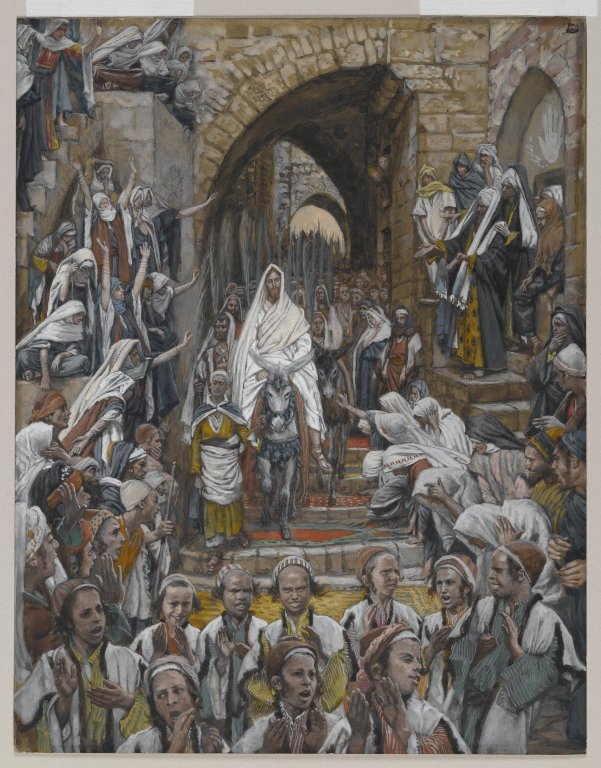
This version of the Palm Sunday Procession with Palms combines elements from several sources. The response: “Blessed is he who comes in the name of the Lord. Hosanna in the highest!” is taken from the Palm Sunday Gospel, and is found in the most ancient Palm Sunday liturgies.

The service begins in the back of the church.

In the name of the Father and of the + Son and of the Holy Spirit.
Amen.

Dear friends in Christ, during Lent we have been preparing for the celebration of Christ’s death and resurrection. Today we come together to begin this solemn celebration with the church throughout the world. Christ entered Jerusalem this day in triumph, a triumph that led through suffering and death to resurrection and new life. In faith and love may we follow our Messiah, this humble ruler, who comes riding on a donkey.

Blessed is he who comes in the name of the Lord.
Hosanna in the highest!

Let us pray.

O God, to love and cherish you is true righteousness. Increase in our hearts the gifts of your grace. Just as you have given us hope for the things we believe through the death of your only Son, by his resurrection lead us to follow him where he has gone; through your Son, Jesus Christ our Lord, who lives and reigns with you and the Holy Spirit, one God, now and forever.
Amen.

A thanksgiving over the palms may be said here:

Let us give thanks to the Lord our God.
It is right to give him thanks and praise.

We give you thanks, almighty and eternal God, for sending your only Son in the fullness of time to redeem the world with his obedient life and innocent death. When he entered Jerusalem he was hailed as king by those who spread their garments and palm branches on his path. We carry these branches as signs of the victory he accomplished. Let his victory remain with us, even as we take up our crosses and follow him, that we may die and rise with him, and finally enter his kingdom; through Jesus Christ our Lord, who lives and reigns with you and the Holy Spirit, one God, now and forever.
Amen.

If Palm Sunday is observed as Passion Sunday, the Palm Sunday Gospel is read here.

The Holy Gospel according to St. _____, the _____ chapter.

A Matthew 21:1-11   B Mark 11:1-10    C Luke 19:28-40

The Gospel of the Lord.
Praise be to you, O Christ.

Let us go forth in peace,
in the name of the Lord.

‘All Glory, Laud, and Honor’ or another Palm Sunday hymn is sung. Children, choirs and others may process to the altar carrying palm branches.

Refrain:
All glory, laud, and honor
to you, Redeemer, King,
to whom the lips of children
made sweet hosannas ring.

1 You are the King of Israel
and David’s royal Son,
now in the Lord’s name coming,
our King and Blessed One. [Refrain]

2 The company of angels
is praising you on high,
and we with all creation
in chorus make reply. [Refrain]

3 The people of the Hebrews
with palms before you went;
our praise and prayers and anthems
before you we present. [Refrain]

4 To you before your passion
they sang their hymns of praise;
to you, now high exalted,
our melody we raise. [Refrain]

5 As you received their praises,
accept the prayers we bring,
O Source of ev’ry blessing,
our good and gracious King. [Refrain]

Blessed is he who comes in the name of the Lord.
Hosanna in the highest!

The service continues with the Prayer (Collect) of the Day and the Lessons.

Narrative paragraph is modified from public domain sources.

Prayer: Freely modified from an ancient collect at the Procession of Palms.

For reference, read this history of Palm Sunday from the Lutheran Missal project. 

Thanksgiving Over the Palms is newly composed for A Collection of Prayers.

Hymn: All Glory, Laud, and Honor is from Hymnary.org.

For a video of a similar liturgy, with the Palm Sunday Gospel read, see this YouTube video:

See also http://www.oremus.org/liturgy/lhwe/ps.html
and: https://en.wikipedia.org/wiki/Palm_Sunday

Richard J. Fairchild

Litany of the Passion (3)

Lord, have mercy.
Christ, have mercy.
Lord, have mercy.

O Christ, hear us.

God the Father of Heaven, have mercy on us.
God the Son, Redeemer of the world, have mercy on us.
God the Holy Spirit, have mercy on us.

Holy Trinity, One God, have mercy on us.

Jesus, the eternal Wisdom,
Jesus, the Word made flesh,
Jesus, hated by the world,
Jesus, sold for thirty pieces of silver,
Jesus, prostrate in prayer,
Jesus, strengthened by an angel,
Jesus, agonizing in a bloody sweat,
Jesus, betrayed by Judas with a kiss,
Jesus, bound by the soldiers,
Jesus, forsaken by your disciples, have mercy on us.

Jesus, before Annas and Caiaphas,
Jesus, struck by a servant on the face,
Jesus, accused by false witnesses,
Jesus, declared worthy of death,
Jesus, spit upon in the face,
Jesus, blindfolded,
Jesus, smitten on the cheek,
Jesus, thrice denied by Peter,
Jesus, delivered up to Pilate,
Jesus, despised and mocked by Herod,
Jesus, clothed in a white garment,
Jesus, rejected for Barabbas,
Jesus, torn by scourges,
Jesus, bruised for our sins, have mercy on us.

Jesus, covered with a purple robe,
Jesus, crowned with thorns,
Jesus, struck with a reed,
Jesus, demanded for crucifixion,
Jesus, condemned to death,
Jesus, given up to your enemies,
Jesus, laden with the Cross,
Jesus, led as a lamb to the slaughter,
Jesus, stripped of your garments,
Jesus, fastened with nails to the Cross,
Jesus, wounded for our iniquities,
Jesus, praying for your murderers,
Jesus, counted with the wicked,
Jesus, blasphemed on the Cross,
Jesus, reviled by the malefactor,
Jesus, giving Paradise to the thief, have mercy on us.

Jesus, commending Saint John to your Mother as her son,
Jesus, forsaken by your Father,
Jesus, given gall and vinegar to drink,
Jesus, testifying that all things written concerning you were accomplished,
Jesus, commending your spirit into the hands of your Father,
Jesus, obedient even unto death,
Jesus, pierced with a lance,
Jesus, made a propitiation for us,
Jesus, taken down from the Cross,
Jesus, laid in the tomb,
Jesus, rising gloriously from the dead,
Jesus, ascending into heaven,
Jesus, our Advocate with the Father,
Jesus, sending down the Holy Spirit,
Jesus, who shall come to judge the living and the dead, have mercy on us.

Be gracious to us. Spare us, good Lord.
Be gracious to us. Help us, good Lord. 

From every evil,
from every sin,
from anger, hatred, and every evil will,
from war, famine, and pestilence,
from all dangers of mind and body,
from everlasting death, Lord Jesus, deliver us.

Through your most pure conception,
through your miraculous nativity,
through your humble circumcision,
through your baptism and fasting,
through your labors and watchings,
through your cruel scourging and crowning,
through your thirst, and tears, and nakedness,
through your precious death and Cross,
through your glorious resurrection and ascension,
through your sending forth the Holy Spirit, the Paraclete,
in the day of judgment, Lord Jesus, deliver us.

We poor sinners pray, hear us, Lord God.

That you would spare us,
that you would pardon us,
that you would bring us to true penance,
that you would pour into our hearts the grace of the Holy Spirit,
that you would defend and propagate your Church,
that you would preserve and increase all societies assembled in your holy Name,
that you would bestow upon us true peace, humility, and charity,
that you would give us perseverance in grace and in your holy service,
that you would deliver us from unclean thoughts, the temptations of the devil, and everlasting damnation,
that you would unite us to the company of your Saints,
that you would graciously hear us, hear us, O Lord.

Lamb of God, you take away the sin of the world; have mercy on us.
Lamb of God, you take away the sin of the world; grant us your peace.

O Christ, hear us.

We adore you, O Christ, and we bless you,
because by your holy Cross you have redeemed the world.

Let us pray.
Almighty and eternal God, you sent your only Son to be the Savior of the world, and your justice was satisfied by his blood. Grant that we may value the price of our salvation, and by its might be defended from the evils of this present life on earth, that in heaven we may rejoice in its everlasting fruit; through Jesus Christ our Lord, who lives and reigns with you and the Holy Spirit, one God, now and forever.
Amen.

Source: Modified from http://www.ewtn.com/Devotionals/Litanies/passion.htm and Litany of the Passion by John Henry Newman, d. 1890.

Litany of the Passion
by John Henry Newman

Lord, have mercy.
Christ, have mercy.
Lord, have mercy.

Christ, hear us.
Christ, graciously hear us.

God the Father of heaven, have mercy on us.
God the Son, Redeemer of the world, have mercy on us.
God the Holy Spirit, have mercy on us.

Holy Trinity, one God, have mercy on us.

Jesus, the eternal Wisdom,
the Word made flesh,
hated by the world,
sold for thirty pieces of silver,
sweating blood in your agony,
betrayed by Judas,
forsaken by your disciples,
struck upon the cheek,
accused by false witnesses,
spit upon in the face,
denied by Peter,
mocked by Herod,
scourged by Pilate,
rejected for Barabbas,
loaded with the cross,
crowned with thorns,
stripped of your garments,
nailed to the tree,
reviled by the Jews,
scoffed at by the malefactor,
wounded in the side,
shedding your last drop of blood,
forsaken by your Father,
dying for our sins,
taken down from the cross,
laid in the tomb,
rising gloriously,
ascending into heaven,
sending down the Paraclete,
Jesus our Sacrifice,
Jesus our Mediator,
Jesus our Judge, have mercy on us.

Be merciful.
Spare us, O Lord.

Be merciful.
Graciously hear us, O Lord.

From all sin,
from all evil,
from anger and hatred,
from malice and revenge,
from unbelief and hardness of heart,
from blasphemy and sacrilege,
from hypocrisy and covetousness,
from blindness of the understanding,
from contempt of your warnings,
from relapse after your judgments,
from danger of soul and body,
from everlasting death, Lord Jesus, deliver us.

We sinners, beseech you, hear us.

That you would spare us,
that you would pardon us,
that you would defend your Church,
that you would bless your own,
that you would convert your foes,
that you would spread the truth,
that you would destroy error,
that you would break to pieces false gods,
that you would increase your elect,
that you would unite us to your Saints above, we beseech you, hear us.

Lamb of God, you take away the sin of the world, spare us, O Lord.
Lamb of God, you take away the sin of the world, graciously hear us, O Lord.
Lamb of God, you take away the sin of the world, have mercy on us.

Christ, hear us.
Christ, graciously hear us.

Lord, have mercy.
Christ, have mercy.
Lord, have mercy.

We adore you, O Christ, and we bless you,
Because through your holy cross you redeemed the world.

Let us pray,

O God,
for the redemption of the world
you were pleased to be born,
to be circumcised,
to be rejected, betrayed and bound,
to be led to the slaughter;
to be shamefully gazed at, falsely accused and scourged,
to be spit upon, crowned with thorns, mocked and reviled,
to be pushed and struck with rods,
to be stripped and nailed to the cross,
to be counted among the transgressors,
to drink gall and vinegar,
to be pierced with a lance.
Through your most holy passion,
which we, your sinful servants, remember,
and by your holy cross and gracious death
deliver us from the pains of hell,
and lead us where you led the thief
who was crucified with you,
where with the Father and the Holy Spirit
you live and reign,
now and forever.
Amen.

Epiphany: Chalking the Door

20+C+M+B+20

On or before the Epiphany, January 6, family and friends gather at the main entrances to homes or apartments and ask God’s blessing on their dwellings and on all who live or visit there. 

Peace be to this house and to all who enter here.

A reading from Proverbs.

With wisdom a house is built. With understanding it is established. With knowledge its rooms are filled with every kind of riches, both valuable and appealing. (Proverbs 24:3-4)

Let us pray.
Gracious God, as a shining star once guided the Wise Men to the infant Jesus, so enable those who dwell here to be your light in the world; through Jesus Christ our Lord.
Amen. 

Using chalk, inscribe the horizontal frame above the door with the inscription shown below. The letters C M B come from the traditional (9th century) names for the “three kings”–Caspar, Melchior, and Balthazar. Some also suggest “Christus Mansionem Benedicat,” which means “May Christ bless this dwelling.” The numbers stand for the year 2020. 

Each person receives a turn to make one or more of the marks:

20 + C + M + B + 20

A reading from Isaiah.

The result of righteousness will be peace, and righteousness will bring lasting tranquility and security. My people will live in a peaceful place, in secure dwellings, and in quiet resting places. (Isaiah 32:17-18).

People may join hands or extend their hands outward and upward (orans) for the prayers.

Let us pray.
Lord God, we pray that you will bless this home and all who live here with your gracious presence, that your love may be our inspiration, your wisdom our guide, your truth our light, and your peace our blessing; through Jesus Christ our Lord.
Amen.

Lord, remember your children and teach us to pray:

Our Father… 

People may make the sign of the cross in remembrance of their baptism.

The Lord + will watch over our going and our coming, now and forever. (Psalm 121:8)
Amen.

Source: Modified from http://www.beliefnet.com/faiths/christianity/2000/12/chalking-the-door.aspx#Qh3a4iy2HKPKIKkE.99

Scripture from the Evangelical Heritage Version.  http://www.wartburgproject.org 

A different rite for chalking the door can be seen here: https://onepeterfive.com/the-chalking-of-the-doors-an-epiphany-tradition-explained/

Christian Prayer, Banner

A Home Liturgy for Thanksgiving Day

The following may be used at home as an extended table prayer / devotion before the Thanksgiving meal.

The eyes of all look eagerly to you,
and you give them their food at the proper time.

God opens his hand,
and he satisfies the desire of every living thing. (Psalm 145:15-16)

A reading from Deuteronomy 8:10–18

10Then you will eat, and you will be filled, and you will praise the Lord your God for the good land that he has given you. 11Be very careful so that you do not forget the Lord your God by not keeping his commandments and ordinances and his statutes that I am commanding you today. 12When you eat and are satisfied, and you build nice houses and move into them, 13and your herds and your flocks multiply, and your silver and gold increase, and everything that you have prospers, 14watch out so that your heart does not become arrogant and forget the Lord your God, who brought you out of the land of Egypt, where you were slaves. 15Do not forget the Lord, who led you in the great and terrifying wilderness, where there were venomous snakes and scorpions, where the thirsty ground had no water, but the Lord made water come out of a flint rock for you. 16Do not forget the Lord, who in the wilderness fed you manna, which your fathers had not known before, to humble you and to test you so that it would be good for you later on. 17You might say in your heart, “My ability and the power of my hand have earned this wealth for me.” 18But then you are to remember that the Lord your God is the one who gives you the ability to produce wealth, to confirm his covenant that he promised to your fathers with an oath, as he does to this day.

The Word of the Lord.
Thanks be to God.

Let us pray.

Lord God, heavenly Father,
from you we receive many abundant blessings without ceasing,
and day by day you graciously protect us from all evil.
We pray,
through your Spirit give us grace
to receive your gifts with thankful hearts,
and to confess the true faith,
so that we may praise and thank you
for your wonderful gifts and graces everywhere;
through your Son, Jesus Christ our Lord.
Amen.

Bless the LORD, O  my soul.
All that is within me, bless his holy name.

Bless the LORD, O my soul,
and do not 
forget all his benefits—

who pardons all your guilt,
who heals all your diseases,

who redeems your life from the pit
who crowns you with mercy and compassion,

who satisfies your life with goodness,
so that your youth is renewed like the eagle. (Psalm 103:1-5)

To the Father who made us,
to the + Son who redeemed us,
to the Spirit who gathers and guides us,
to the King eternal, to the immortal, invisible, only God, be honor and glory forever and ever. Amen. (1 Timothy 1:17).

__________

Prayer “Lord God, heavenly Father, from you we receive…” is from Die pommersche Kirchen-Ordnung und Agenda, p. 295#1, Also in the Saxon Agenda. Translation is from Prayers from the Evangelical-Lutheran Heritage, #180.  All Scripture is taken from The Holy Bible: Evangelical Heritage Version, © 2017. www.wartburgproject.com

© 2017 Paul C. Stratman and A Collection of Prayers.

Christian Prayer, Banner

A Home Liturgy for All Saints Day

In the history of the Christian Church, All Saints Day, November 1, is a time for visiting graves and remembering the faithful departed. The following may be used at home or when visiting the grave of a family member or friend.

We know that the one who raised the Lord + Jesus will also raise us with Jesus and bring us into his presence. (2 Corinthians 4:14)
Amen.

The following Scriptures or other passages may be read:

Now we know that if the tent that is our earthly home is destroyed, we have a building from God, an eternal home in heaven, which is not made by human hands. (2 Corinthians 5:1)

For I am convinced that neither death nor life, neither angels nor rulers, neither things present nor things to come, nor powerful forces, neither height nor depth, nor anything else in creation, will be able to separate us from the love of God in Christ Jesus our Lord. (Romans 8:38-39)

The Word of the Lord.
Thanks be to God.

Let us pray.
Lord Jesus Christ,
you told Mary and Martha
that you are the Resurrection and the Life.
You promised your disciples
that you would prepare a place for them.
You promised the repentant thief
that he would be with you in Paradise.
And through the disciple John,
you revealed to us
that you will wipe away every tear from our eyes
in the Day when there is no death or sorrow or crying or pain.
Fill our hearts
with these firm and certain promises.
Comfort us with the assurance
that those who have died in faith
now see you face to face.
Strengthen us
with these words of your gospel;
you live and reign with the Father and the Holy Spirit,
surrounded by a great multitude that no one can count,
one God, now and forever.
Amen.

How blessed are those who live in your house.
They are always praising you.

How blessed is everyone whose strength is found in you.
The highways to Jerusalem are in their hearts.

As they pass through the Valley of Weeping,
it becomes full of springs. 

They go from strength to strength.
Each one will appear before God in Zion.

O LORD, God of Armies, hear my prayer.
Give ear, O God of Jacob.

One day in your courts is better than a thousand elsewhere.
I would rather wait at the doorway of the house of my God than dwell in the tents of the wicked.

The LORD is a sun and shield.
God gives grace and glory.

The LORD does not withhold any good thing from those who walk with integrity.
O LORD of Armies, how blessed is everyone who trusts in you. (from Psalm 84)

Glory be to the Father and to the Son and to the Holy Spirit.
To him who sits on the throne and to the Lamb be blessing and honor and glory and might forever and ever. (Revelation 5:13)

How blessed are those who live in your house.
They are always praising you.

The peace of God, which surpasses all understanding, will guard your hearts and your minds in Christ + Jesus. (Philippians 4:7)
Amen.

__________

This short rite is based in part on the outline of a short rite in Catholic Household Blessings & Prayers © 2007 by the U. S. Conference of Catholic Bishops. The prayer “Lord Jesus Christ, you told Mary and Martha…” and the responsory from Psalm 84 are newly composed. “Valley of Weeping” is in the footnote. Biblical text reads “Valley of Baca.” All Scripture is taken from The Holy Bible: Evangelical Heritage Version, © 2017.  www.wartburgproject.com

This “Home Liturgy for All Saints Day” has been translated into Portugese, available at lecionario.com website, and viewable below:

Na história da Igreja Cristã, o Dia de Todos os Santos e o Dia de Finados, 1º e 2 de novembro, são momentos para visitar túmulos e lembrar os fiéis que partiram. A liturgia seguinte pode ser usada em casa ou ao visitar o túmulo de um membro da família ou de um amigo.

Sabemos que Aquele que ressuscitou o Senhor + Jesus também nos ressuscitará com Jesus e nos levará à sua presença. (2 Coríntios 4:14 )
Amém.

As seguintes escrituras ou outras passagens podem ser lidas:

Sabemos que, se esta nossa tenda, nossa casa terrena, for destruída, temos um edifício da parte de Deus, uma casa eterna no céu, não feita por mãos humanas. (2 Coríntios 5:1)

Pois tenho certeza de que nem morte, nem vida, nem anjos, nem autoridades celestiais, nem coisas do presente nem do futuro, nem poderes, nem altura, nem profundidade, nem qualquer outra criatura poderá nos separar do amor de Deus, que está em Cristo Jesus, nosso Senhor. (Romanos 8:38–39)

Palavra do Senhor.
Graças a Deus.

Oremos
Senhor Jesus Cristo,
tu disseste a Maria e a Marta
que tu és a ressurreição e a vida.
Tu prometeste aos teus discípulos
que tu prepararias um lugar para eles.
Tu prometeste ao ladrão arrependido
que ele estaria contigo no paraíso.
E através do discípulo João,
tu nos revelaste
que enxugarás cada lágrima dos nossos olhos
no dia em que não haverá morte, nem tristeza, nem choro, nem dor.
Enche nossos corações
com essas firmas e certas promessas.
Conforta-nos com a garantia
de que aqueles que morreram na fé
agora te veem face a face.
Fortalece-nos
com estas palavras do teu evangelho;
tu, que vives e reinas com o Pai e o Espírito Santo,
cercado por uma grande multidão que ninguém pode contar,
um só Deus, agora e sempre.
Amém.

Como são felizes os que habitam em tua casa,
sempre cantando louvores a ti!

Como são felizes os que de ti recebem forças,
os que decidem percorrer os teus caminhos.

Quando passarem pelo vale do Choro,
ele se transformará num lugar de fontes revigorantes;

Eles continuarão a se fortalecer,
e cada um deles se apresentará diante de Deus, em Sião.

Ó Senhor, Deus dos Exércitos, ouve minha oração;
escuta, ó Deus de Jacó!

Um só dia em teus pátios é melhor que mil dias em qualquer outro lugar.
Prefiro ser porteiro da casa de meu Deus
a viver na morada dos perversos.

Pois o Senhor Deus é nosso sol e nosso escudo;
ele nos dá graça e honra.

O Senhor não negará bem algum àqueles que andam no caminho certo.
Ó Senhor dos Exércitos, como são felizes os que confiam em ti!
(do Salmo 84, NVT)

Glória ao Pai e ao Filho e ao Espírito Santo.
Ao que está assentado no trono e ao Cordeiro sejam o louvor,
a honra, a glória e o domínio pelos séculos dos séculos! 
(Apocalipse 5:13)

Como são felizes os que habitam em tua casa,
sempre cantando louvores a ti!

A paz de Deus, que ultrapassa todo entendimento, guardará o vosso coração e os vossos pensamentos em Cristo + Jesus. (Filipenses 4:7).
Amém.

© 2017 Paul C. Stratman and A Collection of Prayers.

Christian Prayer, Banner

Agnus Dei / Lamb of God

File:AGNUS DEI.jpgIn most liturgies, the Agnus Dei immediately follows the Words of Institution. The Agnus Dei is based on John the Baptist’s short sermon, “Behold, the Lamb of God who takes away the sin of the world.” This short song brings the liturgy of the Divine Service to a sort of fulfillment. In the Kyrie we sang “Lord, have mercy. Christ, have mercy. Lord, have mercy.” In the Agnus Dei, this is repeated: “Lamb of God,… have mercy on us,… have mercy on us,… grant us peace.” In the Gloria in Excelsis we sang most of the words while singing the praise of Christ, “Lord God, Lamb of God, you take away the sin of the world: have mercy on us.” The words of the Agnus Dei also reflect on the words of Jesus in the Lord’s Supper, “Given and poured out for you for the forgiveness of sins.”

In one form or another, the Agnus Dei has been part of the Western Rite since the seventh century. It is has been called the “fraction anthem,” meaning that the bread for Holy Communion would be broken while it is sung. In some traditions, the distribution of Holy Communion begins with the Agnus Dei. Here is the standard English text from ELLC:

Lamb of God, you take away the sin of the world,
have mercy on us.
Lamb of God, you take away the sin of the world,
have mercy on us.
Lamb of God, you take away the sin of the world,
grant us peace.

The Latin text and other English versions of the text can be seen in this Wikipedia article.

The German translation from the time of the Reformation added “Christe,” or “O Christ,” either to clarify who the Lamb of God is, or to fill out the meter of the notes so that the German text could be sung to the same notes as the Latin. Here is the German tune from Luther’s Deutsches Messe, “Christe, du Lamm Gottes.” 

Agnus Dei
WELS Book of Hymns, 1920, 1931

And in the video it is sung with the English text, “O Christ, Lamb of God” at the 2017 WELS National Worship Conference.  It is preceded by an intonation and a new harmonization by Kermit Moldenhauer.

Here it is in English with the new standard text in a contemporary setting by Ricky Manalo:

Here is the Latin text, sung to a setting by Samuel Barber. When performed by an orchestra with no choir, it is called the Adagio for Strings. It is very beautiful and haunting with the Latin text:

Here is Agnus Dei from Schubert’s Deutsche Messe. The Agnus Dei is sometimes interpolated or adapted, so instead of “Lamb of God,” the text in some of the petitions may be “Redeemer of the world, have mercy on us,” etc.:

The Nicene Creed

The Emperor Constantine with bishops at the Council of Nicea. Nicholas of Myra is second from the right.

The Nicene Creed was written at the Council of Nicea in A. D. 325, and completed in close to its present form at the Council of Constantinople in A. D. 381. (Sometimes it is called the Niceno-Constantinopolitan Creed.) It was written as a response to confusion about the doctrines of the Trinity and the dual nature of Christ as God and man. It draws heavily from Scripture. You can see a reflection of John chapter 1 in the second article about the dual nature of Christ. It has always been used as a creed of the church, and so it begins “We believe.” The Apostles’ Creed was originally a personal confession of faith at a person’s baptism, and so it begins “I believe.” The Nicene Creed is a part of the Divine Service as the congregation’s response to the Word. “We have heard… and so, we believe.” Later translations changed the first words of each article to the singular “I,” but modern practice has been to return to the original beginning and intent of the creed as the confession of the assembled church.

We believe in one God,
the Father, the Almighty,
maker of heaven and earth,
of all that is, seen and unseen.

We believe in one Lord, Jesus Christ,
the only Son of God,
eternally begotten of the Father,
God from God, Light from Light,
true God from true God,
begotten, not made,
of one Being with the Father;
through him all things were made.
For us and for our salvation
he came down from heaven,
was incarnate of the Holy Spirit and the Virgin Mary
and became truly human.
For our sake he was crucified under Pontius Pilate;
he suffered death and was buried.
On the third day he rose again
in accordance with the Scriptures;
he ascended into heaven
and is seated at the right hand of the Father.
He will come again in glory to judge the living and the dead,
and his kingdom will have no end.

We believe in the Holy Spirit, the Lord, the giver of life,
who proceeds from the Father and the Son,
who with the Father and the Son is worshiped and glorified,
who has spoken through the prophets.
We believe in one holy catholic and apostolic Church.
We acknowledge one baptism for the forgiveness of sins.
We look for the resurrection of the dead,
and the life of the world to come. Amen.

Source: English Language Liturgical Consultation.

Below is the text from the 1928 Book of Common Prayer:

I BELIEVE in one God the Father Almighty, Maker of heaven and earth, And of all things visible and invisible:

And in one Lord Jesus Christ, the only-begotten Son of God; Begotten of his Father before all worlds, God of God, Light of Light, Very God of very God; Begotten, not made; Being of one substance with the Father; By whom all things were made: Who for us men and for our salvation came down from heaven, And was incarnate by the Holy Ghost of the Virgin Mary, And was made man: And was crucified also for us under Pontius Pilate; He suffered and was buried: And the third day he rose again according to the Scriptures: And ascended into heaven, And sitteth on the right hand of the Father: And he shall come again, with glory, to judge both the quick and the dead; Whose kingdom shall have no end.

And I believe in the Holy Ghost, The Lord, and Giver of Life, Who proceedeth from the Father and the Son; Who with the Father and the Son together is worshipped and glorified; Who spake by the Prophets: And I believe one Catholic and Apostolic Church: I acknowledge one Baptism for the remission of sins: And I look for the Resurrection of the dead: And the Life of the world to come. Amen.

Original in Greek:

Πιστεύομεν εἰς ἕνα Θεὸν Πατέρα παντοκράτορα
ποιητὴν οὐρανοῦ καὶ γῆς ὁρατῶν τε πάντων καὶ ἀοράτων·
καὶ εἰς ἕνα Κύριον Ἰησοῦν Χριστὸν
τὸν υἱὸν τοῦ Θεοῦ τὸν Μονογενῆ,
τὸν ἐκ τοῦ Πατρὸς γεννηθέντα πρὸ πάντων τῶν αἰώνων,
Φῶς ἐκ Φωτός,
Θεὸν ἀληθινὸν ἐκ Θεοῦ ἀληθινοῦ,
γεννηθέντα οὐ ποιηθέντα,
ὁμοούσιον τῷ Πατρί,
δι’ οὗ τὰ πάντα ἐγένετο·
τὸν δι’ ἡμᾶς τοὺς ἀνθρώπους καὶ διὰ τὴν ἡμετέραν σωτηρίαν κατελθόντα ἐκ τῶν οὐρανῶν,
καὶ σαρκωθέντα ἐκ Πνεύματος Ἁγίου καὶ Μαρίας τῆς παρθένου,
καὶ ἐνανθρωπήσαντα,
σταυρωθέντα τε ὑπὲρ ἡμῶν ἐπὶ Ποντίου Πιλάτου,
καὶ παθόντα, καὶ ταφέντα,
καὶ ἀναστάντα τῇ τρίτῃ ἡμέρᾳ κατὰ τὰς γραφὰς,
καὶ ἀνελθόντα εἰς τοὺς οὐρανοὺς,
καὶ καθεζόμενον ἐν δεξιᾷ τοῦ Πατρὸς,
καὶ πάλιν ἐρχόμενον μετὰ δόξης κρῖναι ζῶντας καὶ νεκρούς,
οὗ τῆς βασιλείας οὐκ ἔσται τέλος·
καὶ εἰς τὸ Πνεῦμα τὸ Ἅγιον, τὸ Κύριον καὶ Ζωοποιόν,
τὸ ἐκ τοῦ Πατρὸς ἐκπορευόμενον,*
τὸ σὺν Πατρὶ καὶ Υἱῷ συμπροσκυνούμενον καὶ συνδοξαζόμενον,
τὸ λαλῆσαν διὰ τῶν προφητῶν·
εἰς μίαν ἁγίαν καθολικὴν καὶ ἀποστολικὴν ἐκκλησίαν·
ὁμολογοῦμεν ἓν βάπτισμα εἰς ἄφεσιν ἁμαρτιῶν·
προσδοκῶμεν ἀνάστασιν νεκρῶν,
καὶ ζωὴν τοῦ μέλλοντος αἰῶνος. ἀμήν.

*This text was taken from the website of an Eastern Rite church. A point of doctrinal difference in Eastern Rite churches is their teaching that the Holy Spirit proceeds from the Father only. The phrase “and the Son” was added to the Latin version in 1014, and was one of the main reasons for the east-west schism of 1054. John 15:26 does show a proceeding from Father and Son. “When the Counselor comes, whom I will send to you from the Father—the Spirit of truth, who proceeds from the Father—he will testify about me.”

Latin version:

Credo in unum Deum,
Patrem omnipoténtem,
factórem cæli et terræ,
visibílium ómnium et invisibílium.
Et in unum Dóminum, Iesum Christum,
Fílium Dei unigénitum,
et ex Patre natum ante ómnia sǽcula.
Deum de Deo, lumen de lúmine, Deum verum de Deo vero,
génitum, non factum, consubstantiálem Patri:
per quem ómnia facta sunt.
Qui propter nos hómines et propter nostram salútem
descéndit de cælis.
Et incarnátus est de Spíritu Sancto
ex María Vírgine, et homo factus est.
Crucifíxus étiam pro nobis sub Póntio Piláto;
passus et sepúltus est,
et resurréxit tértia die, secúndum Scriptúras,
et ascéndit in cælum, sedet ad déxteram Patris.
Et íterum ventúrus est cum glória,
iudicáre vivos et mórtuos,
cuius regni non erit finis.
Et in Spíritum Sanctum, Dóminum et vivificántem:
qui ex Patre Filióque procédit.
Qui cum Patre et Fílio simul adorátur et conglorificátur:
qui locútus est per prophétas.
Et unam, sanctam, cathólicam et apostólicam Ecclésiam.
Confíteor unum baptísma in remissiónem peccatórum.
Et exspécto resurrectiónem mortuórum,
et vitam ventúri sǽculi. Amen.

Although this is a confession of faith and a doctrinal statement, the Nicene Creed has been set to music. Here it is in Latin as a Gregorian Chant:

Here it is, also in Latin, from Mass in C by Wolfgang Amadeus Mozart:

Since the Reformation, it was the practice in Germany to sing the Creed in the form of a hymn. Here is Luther’s ‘Wir glauben all an einen Gott, Schöpfer…”

is the nicene creed relatable in the 21st century

Gloria in Excelsis / Glory to God in the Highest

The Gloria in Excelsis is a song of praise used in the Divine Service. It’s origin is in the eastern or Greek churches where it was first used as a song of praise in daily morning prayer. In the western churches it is used as the song of praise at the beginning of the Divine Service. It is a song of praise that begins with the text of the song of the angels on Christmas night. It addresses Father, Son and Holy Spirit. The Father’s supreme rule, the Son’s sacrifice and his sitting at his Father’s right hand over all things. It is sometimes called “the greater Gloria” in contrast to the “Gloria Patri.” 

Here is the English text from the Book of Common Prayer:

Glory be to God on high,
and on earth peace, good will towards men.

We praise thee,
we bless thee,
we worship thee,
we glorify thee,
we give thanks to thee for thy great glory,
O Lord God, heavenly King, God the Father Almighty.

O Lord, the only-begotten Son, Jesus Christ;
O Lord God, Lamb of God, Son of the Father,
that takest away the sins of the world,
have mercy upon us.
Thou that takest away the sins of the world,
receive our prayer.
Thou that sittest at the right hand of God the Father,
have mercy upon us.

For thou only art holy;
thou only art the Lord;
thou only, O Christ,
with the Holy Ghost,
art most high in the glory of God the Father. Amen.

Here is the text set to the Anglican Chant tune “Old Scottish Chant.”

Gloria in Excelsis
From Book of Hymns, WELS, 1914.

An early version of the Gloria is found in the Apostolic Constitutions. The translation here is modified from Prayers of the Early Church, edited by J. Manning Potts, 1953:

Glory to God in the highest,
and peace to his people on earth.

We praise you, we sing hymns to you,
we bless you, we glorify you,
we worship you by your great High Priest,
alone as the true God,
the One Unbegotten,
the only inaccessible Being,
for your great glory,
O Lord and heavenly King,
almighty God and Father.

O Lord God, the Father of Christ
the immaculate Lamb,
who takes away the sin of the world,
receive our prayer.
You are seated above the cherubim.

For you alone are the holy One,
you alone are the Lord,
Jesus Christ,
God of all created nature,
our King, to whom belongs
glory, honor, and worship. Amen.

Here is the English text from English Language Liturgical Consultation, 1988, which is the basis for most modern liturgical music. Some textual changes from the Book of Common Prayer were done to avoid some repetition of phrases, and to be closer also to the Greek text.

Glory to God in the highest,
and peace to his people on earth.

Lord God, heavenly King,
almighty God and Father,
we worship you,
we give you thanks,
we praise you for your glory.

Lord Jesus Christ,
only Son of the Father,
Lord God, Lamb of God,
you take away the sin of the world:
have mercy on us;
you are seated at the right hand of the Father:
receive our prayer.

For you alone are the Holy One,
you alone are the Lord,
you alone are the Most High,
Jesus Christ,
with the Holy Spirit,
in the glory of God the Father. Amen.

In Greek:

Δόξα ἐν ὑψίστοις Θεῷ
καὶ ἐπὶ γῆς εἰρήνη ἐν ἀνθρώποις εὐδοκία.

Ὑμνοῦμέν σε,
εὐλογοῦμέν σε,
προσκυνοῦμέν σε,
δοξολογοῦμέν σε,
εὐχαριστοῦμέν σοι, διὰ τὴν μεγάλην σου δόξαν.
Κύριε Βασιλεῦ, ἐπουράνιε Θεέ, Πάτερ παντοκράτορ,

Κύριε Υἱὲ μονογενές, Ἰησοῦ Χριστέ, καὶ Ἅγιον Πνεῦμα.
Κύριε ὁ Θεός, ὁ ἀμνὸς τοῦ Θεοῦ, ὁ Υἱός τοῦ Πατρός,
ὁ αἴρων τὴν ἁμαρτίαν τοῦ κόσμου, ἐλέησον ἡμᾶς,
ὁ αἴρων τὰς ἁμαρτίας τοῦ κόσμου.
Πρόσδεξαι τὴν δέησιν ἡμῶν,
ὁ καθήμενος ἐν δεξιᾷ τοῦ Πατρός, καὶ ἐλέησον ἡμᾶς.
Ὅτι σὺ εἶ μόνος Ἅγιος,
σὺ εἶ μόνος Κύριος,
Ἰησοῦς Χριστός, εἰς δόξαν Θεοῦ Πατρός.
Ἀμήν.

In Latin:

Glória in excélsis Deo
et in terra pax homínibus bonæ voluntátis.

Laudámus te,
benedícimus te,
adorámus te,
glorificámus te,
grátias ágimus tibi propter magnam glóriam tuam,
Dómine Deus, Rex cæléstis,
Deus Pater omnípotens.

Dómine Fili unigénite, Jesu Christe,
Dómine Deus, Agnus Dei, Fílius Patris,
qui tollis peccáta mundi, miserére nobis;
qui tollis peccáta mundi, súscipe deprecatiónem nostram.
Qui sedes ad déxteram Patris, miserére nobis.

Quóniam tu solus Sanctus, tu solus Dóminus,
tu solus Altíssimus,
Jesu Christe,
cum Sancto Spíritu: in glória Dei Patris. Amen.

The Gloria in Excelsis has been set to music thousands of times. Any piece of music called a Mass or a Divine Service would include it. Here it is from Bach’s Mass in B Minor.

And here it is in German by Michael Praetorius:

It is also been the subject of contemporary or folk settings. Here is a setting by Ricky Manalo:

And here it is in Latin as a Gregorian chant:

Along with settings of the prose texts and translations, the Gloria in Excelsis has also been paraphrased into the form of a hymn. Here is “Allein Gott in der Hoh, sei Ehr,” which has been used as the German Gloria since the time of the Reformation:

And here it is in an English translation from The Lutheran Hymnal, from Hymnary.org.


AncientCollectsAd

Kyrie, Eleison / Lord, Have Mercy

Kyrie eleison (KI-ree-ay ay-LAY-ee-zonn) or “Lord, have mercy” is a short prayer that is important in Christian worship. It is a prayer from the heart about human need. God owes us nothing. Everything he gives comes from his mercy. 

Lord, have mercy.
Christ, have mercy.
Lord, have mercy.

Original in Greek:

Κύριε, ἐλέησον.
Χριστέ, ἐλέησον.
Κύριε, ἐλέησον.

Greek transliterated:

Kyrie eleison.
Christe eleison.
Kyrie eleison.

Some worship traditions translate Kyrie eleison as “Lord, have mercy.” Some leave it untranslated as is done for words like “Amen” and “Alleluia.”

Kyrie eleison, Christe eleison, Kyrie eleison are the first words in the main part of the Divine Service, either as a cry of repentance or as a prayer for God’s mercy in all aspects of life.

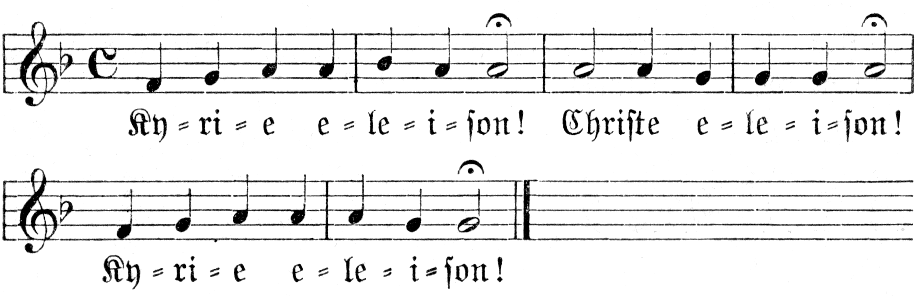
Kyrie eleison Deutsches Messe
Kyrie eleison, found in Evangelisches Gesangbuch für Rheinland und Westfalen, 1902. It was taken from Luther’s Deutsches Messe.
Kyrie.png
The Threefold Kyrie, tune from Luther’s German Mass with English Text. Book of Hymns (WELS, 1920, 1931)

The second use, as a prayer for God’s mercy in all aspects of life, often includes Kyrie eleison or” Lord, have mercy” as a response in a litany that brings the requests for the Lord to have mercy.  The Kyrie as a deacon’s litany or troped Kyrie also has a long history, and is the original use of the Kyrie in the divine service.

See the Kyrie of Dunstan.

The following troped Kyrie litanies are from the Sarum Missal.

I. Pater Creator Omnium (God, creator of all things, our God)

II. Kyrie, Rex genitor ingenite (Lord, King, Father unbegotten, true Being)

III. Kyrie, Fons Bonitatis (Lord, fountain of all goodness)

IV. Kyrie omnipotens pater ingenite (Lord, almighty Father, unbegotten)

V. Kyrie Rex Splendens Celi Arce Salue (Lord, King of glory in the fortress of heaven)

VI. Lux et Origo (Light, source of the highest light)

VII. Cunctipotens Genitor Deus Omnicreator (Almighty King, God, Creator of all things)

VIII. Conditor omnium imas creaturarum (Lord, maker of all creatures)

IX. Kyrie, orbis factor (Lord, creator of the world) 

These short Kyrie litanies are in current use: 

Kyrie from the Church of Finland

Kyrie from the Church of Sweden

In Matins (Morning Prayer) and Vespers (Evening Prayer) Kyrie eleison, Christe eleison, Kyrie eleison or their translation appear in some form at the end of the service before the Lord’s Prayer. A version of “Help, Save, Have Mercy on Us” is currently used by many churches as a responsive Kyrie in Evening Prayer.

As short as the Kyrie is, it has been set to music, both as the short Kyrie, and as a Kyrie with extended petitions.

Here it is from Bach’s Mass in B Minor:

Here it is in German, known to English-speaking Lutherans as “Kyrie, God, Father in heaven above”:

Here it is as a responsive litany, sung by pastor and people. The text uses some of the petitions from “Help, Save, Have Mercy on Us” (Liturgy of St. John Chrysostom). (Video and audio quality aren’t the best, but the performance was led by Regina H. Fryxell, who was the composer / arranger.)  Here the Kyrie is followed by the Gloria.

See also:

Enlightenment and Joy, Wisdom and Comfort, Rest and Peace

KAThe Lord enlighten you
through the teachings of Jesus Christ
and strengthen you as you walk in his light.

The Lord give you joy
as he shows you his Fatherly mercies
new every morning.

The Lord give you wisdom in happiness,
comfort in suffering,
rest in death,
and one day,
the peace of eternal life.

Source: Schleswig-Hosteinsche Kirchen-Agende, 1797, Segenswünsche,  p. 146#5, translated for A Collection of Prayers.

Original in German:

Der Herr erleuchte euch alle durch die Lehre Jesu Christi, und gebe euch Kraft, in ihrem Lichte zu wandeln!

Der Herr erfreue euch taglich durch neue Beweise seiner Vatergüte.

Der Herr gebe euch Weisheit in Glucke, Trost im Leiden, Ruhe im Tode und einst den Frieden des ewigen Lebens!

Translation note:

Literally, the first strophe is “The Lord enlighten you through the teachings of Jesus Christ and strengthen you as you walk in their light.” I thought it was less confusing, and more direct, to say “his light.”

The second strophe is translated more freely to state clearly what the original implies, “his mercies are new every morning.”


EvLuthHeritageAd