Holy, holy, holy Lord,
God almighty!
Heaven and earth
are full of your glory.
We worship you.
We give you thanks for your marvelous deeds,
Lord God, heavenly King,
God and Father, Almighty Lord.
Jesus Christ, only Son of the most high,
Holy Spirit, Spirit of peace, truth and grace,
to you, eternal God, be praise for all your works.
Your might is eternal,
and your love unwavering.
Look with mercy on your people
who gather in your sanctuary to worship you,
to thank you for all your benefits for body and soul,
to implore your grace
to enlighten us in knowledge of you
and to instruct our hearts,
that we may bring the holy offerings
of devout obedience to you.
This canticle seems to blend the Trisagion,an opening hymn in Eastern Orthodox worship, with the Gloria in Excelsis, along with some other elements.
Original in German:
Heiliger! Heiliger! Heiliger! HErr! Gott! Allmächtiger! Himmel und Erde sind Deiner Herrlichkeit voll; wir beten Dich an, wir danken Dir für Deine Wunder, HErr Gott! himmlischer König! Gott Vater! Allmächtiger HErr! eingeborner Sohn des Allerhöchsten! Jesus Christus! Heiliger Geist! Geist des Friedens, der Wahrheit und der Gnade! Dich, ewiger Gott, loben alle Deine Werke; ewig , wie Du selbst, ist Deine Macht, unwandelbar Deine Liebe; blicke mit Milde herab auf Dein Volk, welches versammelt ist in Deinem Heiligthutne, Dich anzubeten, Dir zu danken für Deine Wohlhaten, und für sich, im Geistigen und Leiblichen, Deine Gnade zu erflehen ; erleuchte unsern Verstand zu Deiner Erkenntniss und lehre unsere Herzen, die heiligen Opfer eines ächten Gehorsams darzubringen!
In most liturgies, the Agnus Dei immediately follows the Words of Institution. The Agnus Dei is based on John the Baptist’s short sermon, “Behold, the Lamb of God who takes away the sin of the world.” This short song brings the liturgy of the Divine Service to a sort of fulfillment. In the Kyrie we sang “Lord, have mercy. Christ, have mercy. Lord, have mercy.” In the Agnus Dei, this is repeated: “Lamb of God,… have mercy on us,… have mercy on us,… grant us peace.” In the Gloria in Excelsis we sang most of the words while singing the praise of Christ, “Lord God, Lamb of God, you take away the sin of the world: have mercy on us.” The words of the Agnus Dei also reflect on the words of Jesus in the Lord’s Supper, “Given and poured out for you for the forgiveness of sins.”
In one form or another, the Agnus Dei has been part of the Western Rite since the seventh century. It is has been called the “fraction anthem,” meaning that the bread for Holy Communion would be broken while it is sung. In some traditions, the distribution of Holy Communion begins with the Agnus Dei. Here is the standard English text from ELLC:
Lamb of God, you take away the sin of the world, have mercy on us. Lamb of God, you take away the sin of the world, have mercy on us. Lamb of God, you take away the sin of the world, grant us peace.
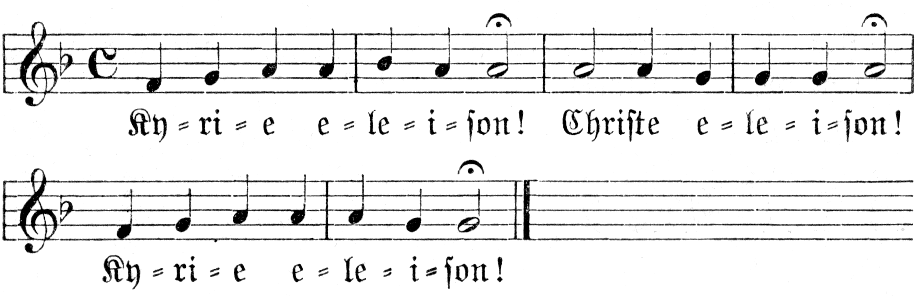
The German translation from the time of the Reformation added “Christe,” or “O Christ,” either to clarify who the Lamb of God is, or to fill out the meter of the notes so that the German text could be sung to the same notes as the Latin. Here is the German tune from Luther’s Deutsches Messe,“Christe, du Lamm Gottes.”
WELS Book of Hymns, 1920, 1931
And in the video it is sung with the English text, “O Christ, Lamb of God” at the 2017 WELS National Worship Conference. It is preceded by an intonation and a new harmonization by Kermit Moldenhauer.
Here it is in English with the new standard text in a contemporary setting by Ricky Manalo:
Here is the Latin text, sung to a setting by Samuel Barber. When performed by an orchestra with no choir, it is called the Adagio for Strings. It is very beautiful and haunting with the Latin text:
Here is AgnusDei from Schubert’s Deutsche Messe. The Agnus Dei is sometimes interpolated or adapted, so instead of “Lamb of God,” the text in some of the petitions may be “Redeemer of the world, have mercy on us,” etc.:
The Sanctus is in the Communion part of the Divine Service. The text comes from Isaiah’s vision of heaven (Isaiah 6) and John’s vision of heaven in Revelation (Revelation 4) and includes a phrase from the Palm Sunday Gospel, “Blessed is he who comes in the name of the Lord. Hosanna in the highest” (Matthew 21:9). It is thought to have this place in the liturgy, at the end of a prayer of thanksgiving before the words of institution, since the fifth century. It’s origins in Christian worship may go back to the second century.
The use of “Holy, holy, holy,” together with “Blessed is he who comes in the name of the Lord” has some doctrinal implications. When they heard the song or shout of the angels, “Holy, holy, holy,” Isaiah and John were in the presence of God. The Palm Sunday acclamation also states, “Your Savior is here.” There is a connection between the Sanctus and the doctrine of the real presence in the Lord’s Supper. (More on that below.)
Holy, holy, holy Lord, God of power and might, heaven and earth are full of your glory. Hosanna in the highest. Blessed is he who comes in the name of the Lord. Hosanna in the highest.
Some arrangements use the phrase: “Lord, God of hosts.”
And the older English text from The Common Service Book of the Lutheran Church. “Sabaoth” is a Hebrew word meaning ‘armies’ or ‘hosts,’ as in the heavenly hosts of angels and all the power of nature. I’ll mention something more about this with the Greek text below:
Holy, Holy, Holy, Lord God of Sabaoth; Heaven and earth are full of Thy glory; Hosanna in the highest. Blessed is He that cometh in the Name of the Lord; Hosanna in the highest.
The Book of Common Prayer inserts “Glory to thee,…” and makes “Blessed is he…” optional. This is because some Anglicans taught real presence and some taught representation in the doctrine of the Lord’s Supper. (I told you it was doctrinal!):
Holy, holy, holy, Lord God of Hosts: Heaven and earth are full of thy Glory. Glory be to thee, O Lord Most High.
Here may be added
Blessed is he that cometh in the name of the Lord. Hosanna in the highest.
The Greek text in Revelation 4 has παντοκρατωρ (pantokrator)instead of Σαβαώθ (Sabaoth).Pantokrator is a word that means “powerful over all.”
Text in Latin:
Sanctus, Sanctus, Sanctus
Dominus Deus Sabaoth.
Pleni sunt cæli et terra gloria tua.
Hosanna in excelsis.
Benedictus qui venit in nomine Domini.
Hosanna in excelsis.
Some musical arrangements try to portray these words with the sublime bliss of heaven. Here’s one based on Pachelbel’s Kanon that is similar to the style of Enya:
Some arrangements seem to focus on the Pantokrator or Sabaoth, that the God who is present, our Saving God who comes to us, is powerful over all. Here it is as it appeared in The Lutheran Hymnal and also in Lutheran Service Book and in Christian Worship: A Lutheran Hymnal’s (1993) Common Service and Christian Worship: Hymnal’s (2021) The Service, Setting One.
WELS, Book of Hymns, 1920, 1931
This recording includes the Sursum Corda (a dialogue before the preface) the chant of the preface, and then the Sanctus. In different liturgy and accompaniment books, I could only find the tune credited as “traditional.” In an older German source (Choralbuch, Concordia, 1902), this tune is listed with the note “Seit c. 1848 allhier verbreitet.” (“Widely used since around 1848”).
Here is another Sanctus that has been used in many Lutheran hymnals, and a version of it is in Lutheran Book of Worship (Setting Two) and Evangelical Lutheran Worship (Setting Four).
From Common Service Book of the Lutheran Church, 1919.
And here is how it appeared in Service Book and Hymnal, 1959. This recording also includes the Sursum Corda/Preface.
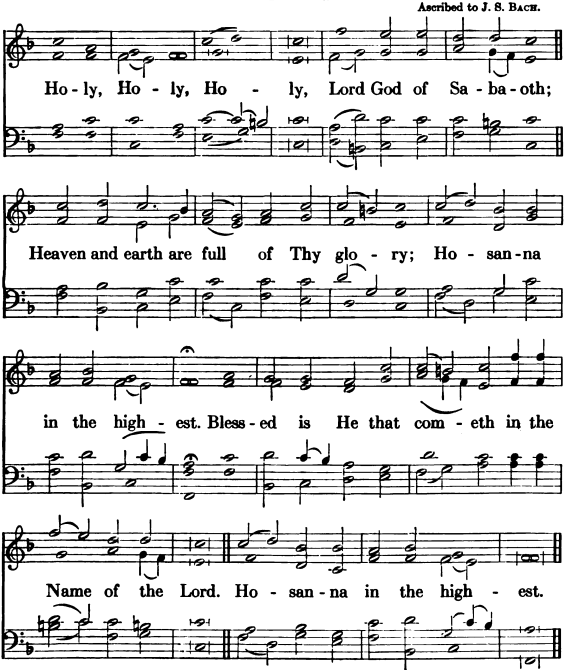
Here is the German text with a tune arranged by Johann Sebastian Bach:
Here is Mozart’s Sanctus. (The video says its from his Requiem, but that is not correct. ):
Here is the Sanctus from Schubert’s Deutsche Messe with rich, romantic harmony:
Luther’s hymn Jesaia, dem Propheten, Isaiah, Mighty Seer in Days of Old retells the vision from Isaiah 6, and among German Lutherans, this hymn took the place of the Sanctus, or was even called the German Sanctus. Here is Isaiah, Mighty Seer sung in English at the 2017 WELS National Worship Conference. It is performed by a children’s choir, adult choir, assembly, organ, brass and percussion. I was there for the performance, and it also conveyed the awe and the power of our thrice-holy God. The recording begins with the Exhortation from Luther’s Deutsches Messe, and is followed by Isaiah, Mighty Seer:
The Emperor Constantine with bishops at the Council of Nicea. Nicholas of Myra is second from the right.
The Nicene Creed was written at the Council of Nicea in A. D. 325, and completed in close to its present form at the Council of Constantinople in A. D. 381. (Sometimes it is called the Niceno-Constantinopolitan Creed.) It was written as a response to confusion about the doctrines of the Trinity and the dual nature of Christ as God and man. It draws heavily from Scripture. You can see a reflection of John chapter 1 in the second article about the dual nature of Christ. It has always been used as a creed of the church, and so it begins “We believe.” The Apostles’ Creed was originally a personal confession of faith at a person’s baptism, and so it begins “I believe.” The Nicene Creed is a part of the Divine Service as the congregation’s response to the Word. “We have heard… and so, we believe.” Later translations changed the first words of each article to the singular “I,” but modern practice has been to return to the original beginning and intent of the creed as the confession of the assembled church.
We believe in one God,
the Father, the Almighty,
maker of heaven and earth,
of all that is, seen and unseen.
We believe in one Lord, Jesus Christ,
the only Son of God,
eternally begotten of the Father,
God from God, Light from Light,
true God from true God,
begotten, not made,
of one Being with the Father;
through him all things were made.
For us and for our salvation
he came down from heaven,
was incarnate of the Holy Spirit and the Virgin Mary
and became truly human.
For our sake he was crucified under Pontius Pilate;
he suffered death and was buried.
On the third day he rose again
in accordance with the Scriptures;
he ascended into heaven
and is seated at the right hand of the Father.
He will come again in glory to judge the living and the dead,
and his kingdom will have no end.
We believe in the Holy Spirit, the Lord, the giver of life,
who proceeds from the Father and the Son,
who with the Father and the Son is worshiped and glorified,
who has spoken through the prophets.
We believe in one holy catholic and apostolic Church.
We acknowledge one baptism for the forgiveness of sins.
We look for the resurrection of the dead,
and the life of the world to come. Amen.
Below is the text from the 1928 Book of Common Prayer:
I BELIEVE in one God the Father Almighty, Maker of heaven and earth, And of all things visible and invisible:
And in one Lord Jesus Christ, the only-begotten Son of God; Begotten of his Father before all worlds, God of God, Light of Light, Very God of very God; Begotten, not made; Being of one substance with the Father; By whom all things were made: Who for us men and for our salvation came down from heaven, And was incarnate by the Holy Ghost of the Virgin Mary, And was made man: And was crucified also for us under Pontius Pilate; He suffered and was buried: And the third day he rose again according to the Scriptures: And ascended into heaven, And sitteth on the right hand of the Father: And he shall come again, with glory, to judge both the quick and the dead; Whose kingdom shall have no end.
And I believe in the Holy Ghost, The Lord, and Giver of Life, Who proceedeth from the Father and the Son; Who with the Father and the Son together is worshipped and glorified; Who spake by the Prophets: And I believe one Catholic and Apostolic Church: I acknowledge one Baptism for the remission of sins: And I look for the Resurrection of the dead: And the Life of the world to come. Amen.
*This text was taken from the website of an Eastern Rite church. A point of doctrinal difference in Eastern Rite churches is their teaching that the Holy Spirit proceeds from the Father only. The phrase “and the Son” was added to the Latin version in 1014, and was one of the main reasons for the east-west schism of 1054. John 15:26 does show a proceeding from Father and Son. “When the Counselor comes, whom I will send to you from the Father—the Spirit of truth, who proceeds from the Father—he will testify about me.”
Latin version:
Credo in unum Deum,
Patrem omnipoténtem,
factórem cæli et terræ,
visibílium ómnium et invisibílium.
Et in unum Dóminum, Iesum Christum,
Fílium Dei unigénitum,
et ex Patre natum ante ómnia sǽcula.
Deum de Deo, lumen de lúmine, Deum verum de Deo vero,
génitum, non factum, consubstantiálem Patri:
per quem ómnia facta sunt.
Qui propter nos hómines et propter nostram salútem
descéndit de cælis.
Et incarnátus est de Spíritu Sancto
ex María Vírgine, et homo factus est.
Crucifíxus étiam pro nobis sub Póntio Piláto;
passus et sepúltus est,
et resurréxit tértia die, secúndum Scriptúras,
et ascéndit in cælum, sedet ad déxteram Patris.
Et íterum ventúrus est cum glória,
iudicáre vivos et mórtuos,
cuius regni non erit finis.
Et in Spíritum Sanctum, Dóminum et vivificántem:
qui ex Patre Filióque procédit.
Qui cum Patre et Fílio simul adorátur et conglorificátur:
qui locútus est per prophétas.
Et unam, sanctam, cathólicam et apostólicam Ecclésiam.
Confíteor unum baptísma in remissiónem peccatórum.
Et exspécto resurrectiónem mortuórum,
et vitam ventúri sǽculi. Amen.
Although this is a confession of faith and a doctrinal statement, the Nicene Creed has been set to music. Here it is in Latin as a Gregorian Chant:
Here it is, also in Latin, from Mass in C by Wolfgang Amadeus Mozart:
Since the Reformation, it was the practice in Germany to sing the Creed in the form of a hymn. Here is Luther’s ‘Wir glauben all an einen Gott, Schöpfer…”
The Gloria in Excelsis is a song of praise used in the Divine Service. It’s origin is in the eastern or Greek churches where it was first used as a song of praise in daily morning prayer. In the western churches it is used as the song of praise at the beginning of the Divine Service. It is a song of praise that begins with the text of the song of the angels on Christmas night. It addresses Father, Son and Holy Spirit. The Father’s supreme rule, the Son’s sacrifice and his sitting at his Father’s right hand over all things. It is sometimes called “the greater Gloria” in contrast to the “Gloria Patri.”
Here is the English text from the Book of Common Prayer:
Glory be to God on high, and on earth peace, good will towards men.
We praise thee, we bless thee, we worship thee, we glorify thee, we give thanks to thee for thy great glory, O Lord God, heavenly King, God the Father Almighty.
O Lord, the only-begotten Son, Jesus Christ; O Lord God, Lamb of God, Son of the Father, that takest away the sins of the world, have mercy upon us. Thou that takest away the sins of the world, receive our prayer. Thou that sittest at the right hand of God the Father, have mercy upon us.
For thou only art holy; thou only art the Lord; thou only, O Christ, with the Holy Ghost, art most high in the glory of God the Father. Amen.
Here is the text set to the Anglican Chant tune “Old Scottish Chant.”
From Book of Hymns, WELS, 1914.
An early version of the Gloria is found in the Apostolic Constitutions. The translation here is modified from Prayers of the Early Church, edited by J. Manning Potts, 1953:
Glory to God in the highest, and peace to his people on earth.
We praise you, we sing hymns to you, we bless you, we glorify you, we worship you by your great High Priest, alone as the true God, the One Unbegotten, the only inaccessible Being, for your great glory, O Lord and heavenly King, almighty God and Father.
O Lord God, the Father of Christ the immaculate Lamb, who takes away the sin of the world, receive our prayer. You are seated above the cherubim.
For you alone are the holy One, you alone are the Lord, Jesus Christ, God of all created nature, our King, to whom belongs glory, honor, and worship. Amen.
Here is the English text from English Language Liturgical Consultation, 1988, which is the basis for most modern liturgical music. Some textual changes from the Book of Common Prayer were done to avoid some repetition of phrases, and to be closer also to the Greek text.
Glory to God in the highest, and peace to his people on earth.
Lord God, heavenly King, almighty God and Father, we worship you, we give you thanks, we praise you for your glory.
Lord Jesus Christ, only Son of the Father, Lord God, Lamb of God, you take away the sin of the world: have mercy on us; you are seated at the right hand of the Father: receive our prayer.
For you alone are the Holy One, you alone are the Lord, you alone are the Most High, Jesus Christ, with the Holy Spirit, in the glory of God the Father. Amen.
Glória in excélsis Deo et in terra pax homínibus bonæ voluntátis.
Laudámus te, benedícimus te, adorámus te, glorificámus te, grátias ágimus tibi propter magnam glóriam tuam, Dómine Deus, Rex cæléstis, Deus Pater omnípotens.
Dómine Fili unigénite, Jesu Christe, Dómine Deus, Agnus Dei, Fílius Patris, qui tollis peccáta mundi, miserére nobis; qui tollis peccáta mundi, súscipe deprecatiónem nostram. Qui sedes ad déxteram Patris, miserére nobis.
Quóniam tu solus Sanctus, tu solus Dóminus, tu solus Altíssimus, Jesu Christe, cum Sancto Spíritu: in glória Dei Patris. Amen.
The Gloria in Excelsis has been set to music thousands of times. Any piece of music called a Mass or a Divine Service would include it. Here it is from Bach’s Mass in B Minor.
And here it is in German by Michael Praetorius:
It is also been the subject of contemporary or folk settings. Here is a setting by Ricky Manalo:
And here it is in Latin as a Gregorian chant:
Along with settings of the prose texts and translations, the Gloria in Excelsis has also been paraphrased into the form of a hymn. Here is “Allein Gott in der Hoh, sei Ehr,” which has been used as the German Gloria since the time of the Reformation:
And here it is in an English translation from The Lutheran Hymnal, from Hymnary.org.
Kyrie eleison (KI-ree-ay ay-LAY-ee-zonn) or “Lord, have mercy” is a short prayer that is important in Christian worship. It is a prayer from the heart about human need. God owes us nothing. Everything he gives comes from his mercy.
Lord, have mercy. Christ, have mercy. Lord, have mercy.
Original in Greek:
Κύριε, ἐλέησον. Χριστέ, ἐλέησον. Κύριε, ἐλέησον.
Greek transliterated:
Kyrie eleison. Christe eleison. Kyrie eleison.
Some worship traditions translate Kyrie eleison as “Lord, have mercy.” Some leave it untranslated as is done for words like “Amen” and “Alleluia.”
Kyrie eleison, Christe eleison, Kyrie eleison are the first words in the main part of the Divine Service, either as a cry of repentance or as a prayer for God’s mercy in all aspects of life.
Kyrie eleison, found in Evangelisches Gesangbuch für Rheinland und Westfalen, 1902. It was taken from Luther’s Deutsches Messe.The Threefold Kyrie, tune from Luther’s German Mass with English Text. Book of Hymns (WELS, 1920, 1931)
The second use, as a prayer for God’s mercy in all aspects of life, often includes Kyrie eleison or” Lord, have mercy” as a response in a litany that brings the requests for the Lord to have mercy. The Kyrie as a deacon’s litany or troped Kyrie also has a long history, and is the original use of the Kyrie in the divine service.
In Matins (Morning Prayer) and Vespers (Evening Prayer)Kyrie eleison, Christe eleison, Kyrie eleison or their translation appear in some form at the end of the service before the Lord’s Prayer. A version of “Help, Save, Have Mercy on Us” is currently used by many churches as a responsive Kyrie in Evening Prayer.
As short as the Kyrie is, it has been set to music, both as the short Kyrie, and as a Kyrie with extended petitions.
Here it is from Bach’s Mass in B Minor:
Here it is in German, known to English-speaking Lutherans as “Kyrie, God, Father in heaven above”:
Here it is as a responsive litany, sung by pastor and people. The text uses some of the petitions from “Help, Save, Have Mercy on Us” (Liturgy of St. John Chrysostom). (Video and audio quality aren’t the best, but the performance was led by Regina H. Fryxell, who was the composer / arranger.) Here the Kyrie is followed by the Gloria.
See also:
Sarum Kyries: nine short litanies, showing the origin of the names of some of the Gregorian mass settings (Fons bonitatis, Orbis Factor, Lux et origo, Rex Genitor, etc.). These are likely the original Kyrie litanies.
My soul magnifies the Lord,
and my spirit rejoices in God my Savior,
for he has looked on the humble estate of his servant.
For behold, from now on all generations will call me blessed;
for he who is mighty has done great things for me,
and holy is his name.
And his mercy is for those who fear him
from generation to generation.
He has shown strength with his arm;
he has scattered the proud in the thoughts of their hearts;
he has brought down the mighty from their thrones
and exalted those of humble estate;
he has filled the hungry with good things,
and the rich he has sent away empty.
He has helped his servant Israel,
in remembrance of his mercy,
as he spoke to our fathers,
to Abraham and to his offspring forever.
Glory be to the Father, and to the Son, and to the Holy Spirit:
as it was in the beginning, is now, and will be forever. Amen.
The canticle Great Indeed Is the Mystery of Godliness (A Song of Christ’s Appearing) was used in the Roman Liturgy of the Hours in Evening Prayer on Transfiguration.
Great indeed is the mystery of godliness:
He was manifested in the flesh,
vindicated by the Spirit,
seen by angels,
proclaimed among the nations,
believed on in the world,
taken up in glory.
Glory be to the Father, and to the Son, and to the Holy Spirit:
as it was in the beginning, is now, and will be forever. Amen.
Source: The Holy Bible: English Standard Version, 1 Timothy 3:16
This ancient hymn and confession of faith is known as the Te Deum Laudamus.
We praise thee, O God, we acknowledge thee to be the Lord.
All the earth doth worship thee, the Father everlasting.
To thee all Angels cry aloud, the Heavens, and all the Powers therein.
To thee Cherubim and Seraphim, continually do cry,
Holy, Holy, Holy, Lord God of Hosts;
Heaven and earth are full of the Majesty, of thy glory.
The glorious company of the Apostles, praise thee.
The goodly fellowship of the Prophets, praise thee.
The noble army of Martyrs, praise thee.
The holy Church throughout all the world, doth acknowledge thee;
The Father, of an infinite Majesty;
Thine honourable, true, and only Son;
Also the Holy Ghost, the Comforter.
Thou art the King of Glory, O Christ.
Thou art the everlasting Son, of the Father.
When thou tookest upon thee to deliver man, thou didst not abhor the Virgin’s womb.
When thou hadst overcome the sharpness of death,
thou didst open the Kingdom of Heaven to all believers.
Thou sittest at the right hand of God, in the glory of the Father.
We believe that thou shalt come, to be our Judge.
We therefore pray thee, help thy servants,
whom thou hast redeemed with thy precious blood.
Make them to be numbered with thy Saints, in glory everlasting.
[added later, mainly from Psalm verses:]
O Lord, save thy people, and bless thine heritage.
Govern them, and lift them up for ever.
Day by day, we magnify thee;
And we worship thy Name, ever world without end.
Vouchsafe, O Lord, to keep us this day without sin.
O Lord, have mercy upon us, have mercy upon us.
O Lord, let thy mercy lighten upon us, as our trust is in thee.
O Lord, in thee have I trusted, let me never be confounded.
A text modified from the Book of Common Prayer, sung to Anglican chant:
A contemporary rendering of both text and musical setting:
Contemporary version of the text:
We praise you, O God,
we acclaim you as Lord;
all creation worships you,
the Father everlasting.
To you all angels, all the powers of heaven,
the cherubim and seraphim, sing in endless praise:
Holy, holy, holy Lord, God of power and might,
heaven and earth are full of your glory.
The glorious company of apostles praise you.
The noble fellowship of prophets praise you.
The white-robed army of martyrs praise you.
Throughout the world the holy Church acclaims you:
Father, of majesty unbounded,
your true and only Son, worthy of all praise,
the Holy Spirit, advocate and guide.
You, Christ, are the king of glory,
the eternal Son of the Father.
When you took our flesh to set us free
you humbly chose the Virgin’s womb.
You overcame the sting of death
and opened the kingdom of heaven to all believers.
You are seated at God’s right hand in glory.
We believe that you will come to be our judge.
Come then, Lord, and help your people,
bought with the price of your own blood,
and bring us with your saints
to glory everlasting.
[Save your people, Lord, and bless your inheritance.
Govern and uphold them now and always.
Day by day we bless you.
We praise your name for ever.
Keep us today, Lord, from all sin.
Have mercy on us, Lord, have mercy.
Lord, show us your love and mercy,
for we have put our trust in you.
In you, Lord, is our hope:
let us never be put to shame.]
Te Deum laudámus: te Dominum confitémur.
Te ætérnum Patrem omnis terra venerátur.
Tibi omnes Angeli; tibi cæli et univérsae potestátes.
Tibi Chérubim et Séraphim incessábili voce proclámant:
Sanctus, Sanctus, Sanctus, Dóminus Deus Sábaoth.
Pleni sunt cæli et terra majestátis glóriæ tuæ.
Te gloriósus Apostolórum chorus;
Te Prophetárum laudábilis númerus;
Te Mártyrum candidátus laudat exércitus.
Te per orbem terrárum sancta confitétur Ecclésia:
Patrem imménsæ majestátis;
Venerándum tuum verum et únicum Fílium;
Sanctum quoque Paráclitum Spíritum.
Tu Rex glóriæ, Christe.
Tu Patris sempitérnus es Fílius.
Tu ad liberándum susceptúrus hóminem, non horruísti Vírginis úterum.
Tu, devícto mortis acúleo,
aperuísti credéntibus regna cælórum.
Tu ad déxteram Dei sedes, in glória Patris.
Judex créderis esse ventúrus.
Te ergo quǽsumus, tuis fámulis súbveni,
quos pretióso sánguine redemísti.
Ætérna fac cum sanctis tuis in glória numerári.
Salvum fac pópulum tuum, Dómine, et bénedic hæreditáti tuæ.
Et rege eos, et extólle illos usque in ætérnum.
Per síngulos dies benedícimus te.
Et laudámus nomen tuum in sǽculum, et in sǽculum sǽculi.
Dignáre, Dómine, die isto sine peccáto nos custodíre.
Miserére nostri, Dómine, miserére nostri.
Fiat misericórdia tua, Dómine, super nos, quemádmodum sperávimus in te.
In te, Dómine, sperávi: non confúndar in ætérnum.
The Canticle “I Will Give Thanks” (Confiteor Tibi) is taken from Isaiah 12:1-6. In the 1979 Book of Common Prayer it was called The First Song of Isaiah, Ecce Deus.
I will give thanks to you, O LORD, for though you were angry with me,
your anger turned away, that you might comfort me.
Behold, God is my salvation;
I will trust, and will not be afraid;
for the LORD GOD is my strength and my song,
and he has become my salvation.
With joy you will draw water
from the wells of salvation.
And you will say in that day:
Give thanks to the LORD, call upon his name,
make known his deeds among the peoples,
proclaim that his name is exalted.
Sing praises to the LORD, for he has done gloriously;
let this be made known in all the earth.
Shout, and sing for joy, O inhabitant of Zion,
for great in your midst is the Holy One of Israel.
Glory be to the Father, and to the Son, and to the Holy Spirit:
as it was in the beginning, is now, and will be forever. Amen.
Source: Holy Bible: English Standard Version.
The text of this canticle has been given a contemporary setting. The text is the translation in the 1979 Book of Common Prayer.
Text from the 1979 U. S. Book of Common Prayer (Episcopal) in Daily Morning Prayer, Rite Two.
9 The First Song of Isaiah Ecce, Deus Isaiah 12:2-6
Surely, it is God who saves me; *
I will trust in him and not be afraid.
For the Lord is my stronghold and my sure defense, *
and he will be my Savior.
Therefore you shall draw water with rejoicing *
from the springs of salvation.
And on that day you shall say, *
Give thanks to the Lord and call upon his Name;
Make his deeds known among the peoples; *
see that they remember that his Name is exalted.
Sing the praises of the Lord, for he has done great things, *
and this is known in all the world.
Cry aloud, inhabitants of Zion, ring out your joy, *
for the great one in the midst of you is the Holy One of Israel.
Glory to the Father, and to the Son, and to the Holy Spirit: *
as it was in the beginning, is now, and will be for ever. Amen.


 In most liturgies, the





 A Collection of Prayers
_by_shakko.jpg)