Kyrie, Eleison / Lord, Have Mercy

Kyrie eleison (KI-ree-ay ay-LAY-ee-zonn) or “Lord, have mercy” is a short prayer that is important in Christian worship. It is a prayer from the heart about human need. God owes us nothing. Everything he gives comes from his mercy. 

Lord, have mercy.
Christ, have mercy.
Lord, have mercy.

Original in Greek:

Κύριε, ἐλέησον.
Χριστέ, ἐλέησον.
Κύριε, ἐλέησον.

Greek transliterated:

Kyrie eleison.
Christe eleison.
Kyrie eleison.

Some worship traditions translate Kyrie eleison as “Lord, have mercy.” Some leave it untranslated as is done for words like “Amen” and “Alleluia.”

Kyrie eleison, Christe eleison, Kyrie eleison are the first words in the main part of the Divine Service, either as a cry of repentance or as a prayer for God’s mercy in all aspects of life.
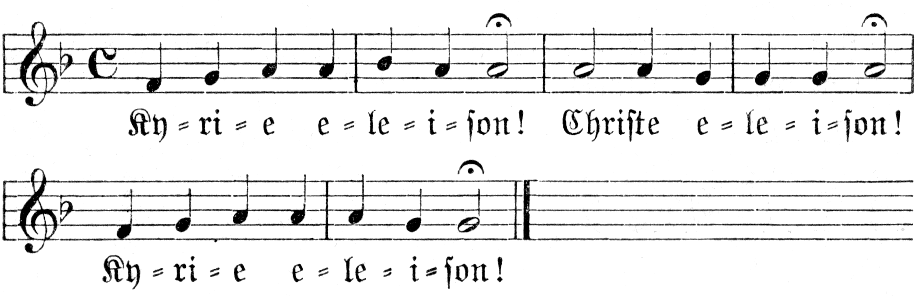
Kyrie eleison Deutsches Messe
Kyrie eleison, found in Evangelisches Gesangbuch für Rheinland und Westfalen, 1902. It was taken from Luther’s Deutsches Messe.
Kyrie.png
The Threefold Kyrie, tune from Luther’s German Mass with English Text. Book of Hymns (WELS, 1920, 1931)

The second use, as a prayer for God’s mercy in all aspects of life, often includes Kyrie eleison or” Lord, have mercy” as a response in a litany that brings the requests for the Lord to have mercy.  The Kyrie as a deacon’s litany or troped Kyrie also has a long history, and is the original use of the Kyrie in the divine service.

See the Kyrie of Dunstan.

The following troped Kyrie litanies are from the Sarum Missal.

I. Pater Creator Omnium (God, creator of all things, our God)

II. Kyrie, Rex genitor ingenite (Lord, King, Father unbegotten, true Being)

III. Kyrie, Fons Bonitatis (Lord, fountain of all goodness)

IV. Kyrie omnipotens pater ingenite (Lord, almighty Father, unbegotten)

V. Kyrie Rex Splendens Celi Arce Salue (Lord, King of glory in the fortress of heaven)

VI. Lux et Origo (Light, source of the highest light)

VII. Cunctipotens Genitor Deus Omnicreator (Almighty King, God, Creator of all things)

VIII. Conditor omnium imas creaturarum (Lord, maker of all creatures)

IX. Kyrie, orbis factor (Lord, creator of the world) 

These short Kyrie litanies are in current use: 

Kyrie from the Church of Finland

Kyrie from the Church of Sweden

In Matins (Morning Prayer) and Vespers (Evening Prayer) Kyrie eleison, Christe eleison, Kyrie eleison or their translation appear in some form at the end of the service before the Lord’s Prayer. A version of “Help, Save, Have Mercy on Us” is currently used by many churches as a responsive Kyrie in Evening Prayer.

As short as the Kyrie is, it has been set to music, both as the short Kyrie, and as a Kyrie with extended petitions.

Here it is from Bach’s Mass in B Minor:

Here it is in German, known to English-speaking Lutherans as “Kyrie, God, Father in heaven above”:

Here it is as a responsive litany, sung by pastor and people. The text uses some of the petitions from “Help, Save, Have Mercy on Us” (Liturgy of St. John Chrysostom). (Video and audio quality aren’t the best, but the performance was led by Regina H. Fryxell, who was the composer / arranger.)  Here the Kyrie is followed by the Gloria.

See also:

Confessing the Faith

On June 25, Lutherans remember the presentation of the Augsburg Confession. On June 25, 1530, Lutheran princes stood before Holy Roman Emperor Charles V at the Diet of Augsburg and presented their confession of faith.

Lord Jesus Christ,
before your ascension,
you told your disciples
to keep all the instructions
you had given them,
and then you promised
to be with your disciples
even to the end of the world.
We give thanks for those
who boldly confessed your truth
at the Diet of Augsburg
and for all Christians
in all times and in all places
who are persecuted, threatened
and even killed
because they proclaim your Word.
Bless your Word
and all who confess and teach it,
that your good news
may spread to all creation,
and that people
now and in years to come
learn your truth
and find eternal life
with you.
Amen.

Source: Paul C. Stratman © 2017.

“Lord Jesus Christ, before your ascension,…” is a reference to Matthew 28:20

“…who are persecuted, threatened and even killed…” is a reference to Romans 8:35

“now and in years to come…” is a reference to Psalm 78:4

“…and find eternal life with you…” is a reference to John 17:3

Prayer for the Third Sunday after Pentecost

O God, you alone are holy,
by your grace you have purified the unholy,
and have written our names in heaven.
Continue to sanctify us by your Spirit
and cleanse us from every spot of sin,
that we may live to your glory;
through Jesus Christ,
our most blessed Lord and Savior.
Amen.

Source: Based upon Mozarabic Collects, ed. Rev. Chas. R. Hale, New York, 1881, p. 30 #3 (Trinity 2)

Original reads: O God, you alone are holy, by your grace you purify the unholy. Cleanse us from every spot of sin, so that, justified by you, our names may be written in heaven; through Jesus Christ, our most blessed Lord and Savior. Amen.

“O God, you alone are holy” is a reference to Revelation 15:4

“you have purified the unholy” is a reference to Malachi 3:3

“written our names in heaven” is a reference to Isaiah 6:6-7

“cleanse us from every spot of sin” is a reference to 1 John 1:7, See also Psalm 51:2


Mozarabic, ad.


Canticle: The Benedictus

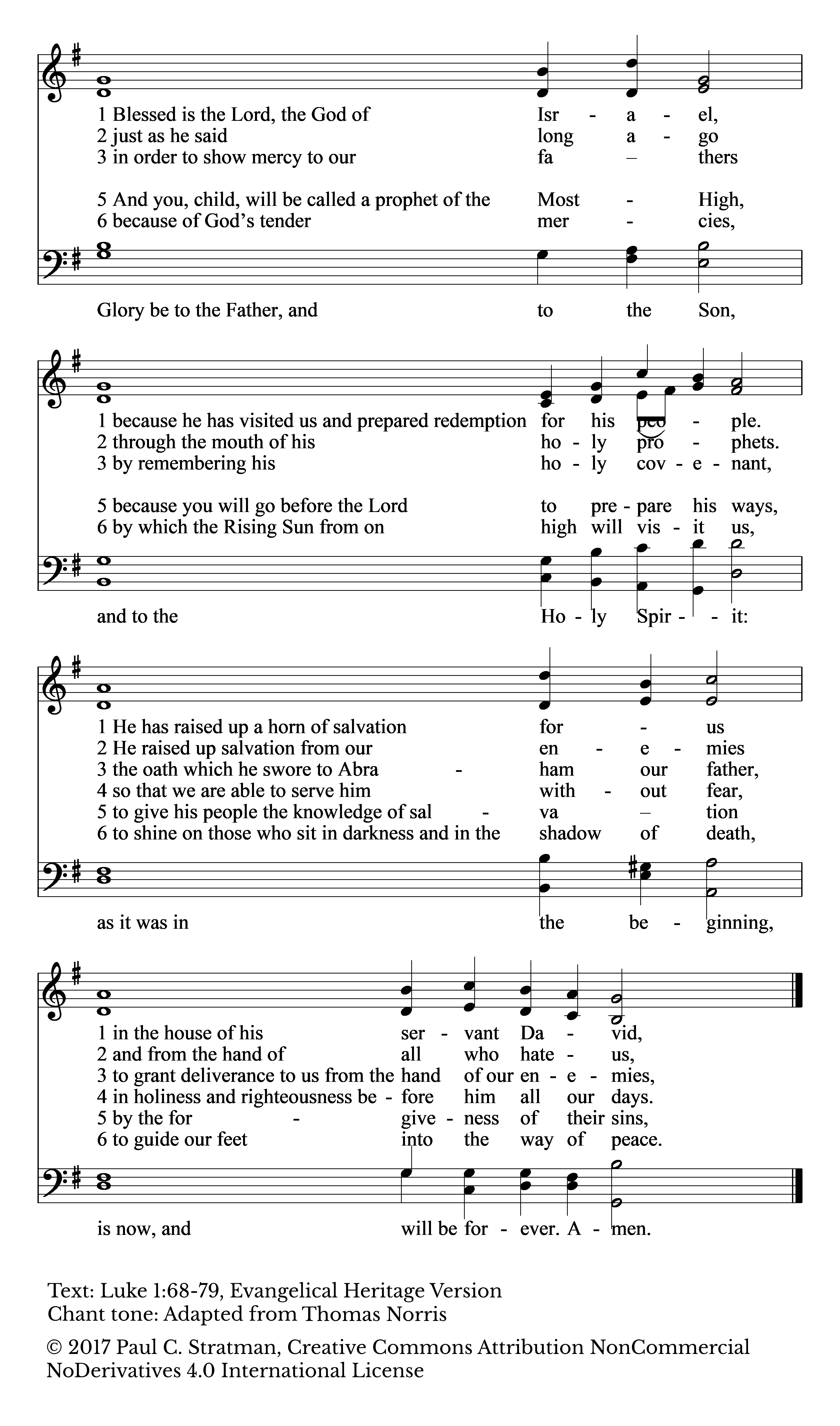
The canticle The Benedictus is taken from Luke 1:68-79, a psalm-like prayer sung or recited by Zechariah, father of John the Baptist, when he regained his speech.

Blessed is the Lord, the God of Israel,
because he has visited us and prepared redemption for his people.
He has raised up a horn of salvation for us in the house of his servant David,
just as he said long ago through the mouth of his holy prophets.
He raised up salvation from our enemies and from the hand of all who hate us,
in order to show mercy to our fathers by remembering his holy covenant,
the oath which he swore to Abraham our father,
to grant deliverance to us from the hand of our enemies,
so that we are able to serve him without fear,
in holiness and righteousness before him all our days.
And you, child, will be called a prophet of the Most High,
because you will go before the Lord to prepare his ways,
to give his people the knowledge of salvation by the forgiveness of their sins,
because of God’s tender mercies,
which the Rising Sun from on high will visit us,
to shine on those who sit in darkness and in the shadow of death,
to guide our feet into the way of peace.

Glory be to the Father, and to the Son, and to the Holy Spirit:
as it was in the beginning, is now, and will be forever. Amen.

Source: The Holy Bible: Evangelical Heritage Version (www.wartburgproject.org).


Text from Evangelical Heritage Version (www.wartburgproject.org). Anglican chant musical setting by Thomas Norris (1741-1790)

Benedictus EHV.png

John the Baptist

Dear Lord God,
we thank and praise you
for giving us
the blessed John the Baptist
and for his joyful preaching
and blessed pointing
to Christ the Lamb of God,
that we may know
where to find salvation
and eternal life
so that we may have
comfort and redemption
against sin and death
and that God’s goodness and grace
may comfort us forever.
God grant this to us all.
Amen.

Source: Martin Luther in Gebetbuch, enthaltend die sämtlichen Gebete und Seufzer Martin Luther’s… p. 388-389.    [Die Gebete Luthers, #677] Translated for A Collection of Prayers.

Wir danken dir, lieber Herr Gott, und loben dich, daß du uns den lieben Johannes gegeben, und durch ihn das fröhliche Wort und den seligen Finger hast kommen lassen, welcher auf Christum, das Lamm Gottes, gewiesen, daß wir wissen, wo wir Seligkeit und ewiges Leben finden sollen, daß wir wider die Sünde und Tod Trost und Erlösung haben, und Gottes Güte und Gnade uns in Ewigkeit trösten mögen. Das verleihe Gott uns allen. Amen.

EvLuthHeritageAd

About the Mozarabic Rite

The People

“Mozarabic” is really a term historians use for Christians who lived in Spain under Muslim or Arab rule. It literally means “among the Arabs.” The people never would have called themselves “Mozarabs.”

The Rite

The Mozarabic Rite (sometimes called the Visigothic, Hispanic or Andalusian Rite) had its beginnings in the seventh century with the invasion of the Arabs from the south and the southern Spanish Christians being cut off from the rest of Europe. It was a complete rite tradition, that is, they developed liturgies and prayers for the church year independently of Rome–most probably because of their isolation under Arab rule. Mozarabic liturgy and prayer are similar to the Mass and prayers of the Roman rite, only the prayers (collects) seem to be a bit freer in form and a bit more substantial in meaning than the prayers from the Gregorian or Gelasian sacramentaries. There is a connection between the Mozarabic Christians and the Eastern Rite Christians (Greek/Eastern Orthodox). Some scholars also see some traces of the worship of early Celtic Christians in the Mozarabic Rite (2000 Years of Prayer, ed. Michael Counsell, p. 84).

Why So Much Mozarabic?

MCSince the Mozarabic Rite developed its own rites and prayers for each Sunday and the liturgies of the hours each day there are a lot of prayers from the Mozarabic tradition out there. Since  A Collection of Prayers is about meaning in prayers and gathering prayers that are rich in meaning, the Mozarabic Rite has become a favorite source. The chief source for Mozarabic prayers is the book Mozarabic Collects based on the translation and arrangement from the Ancient Liturgy of the Spanish Church by the Rev. Charles R. HaleWhen I found the book last year, I got the electronic text from the pdf, and began reworking the English text to preserve and emphasize meaning. The result was The New Mozarabic Collects: A Revision and Refreshing of ‘Mozarabic Collects’ by Charles R. Hale (Available for Kindle only).

There are other prayers that I find from time to time that are ascribed to the the following sources:

  • B_Escorial_93v[1].jpgMozarabic Rite or Mozarabic Liturgy (this would include everything related to the worship of Mozarabic Christians.)
  • Mozarabic Sacramentary (A Sacramentary is a book that would be on the altar containing all liturgy and prayers needed to conduct a service. The Mozarabic Collects would be from the Sacramentary)
  • Mozarabic Breviary (A Breviary is a small book of prayers, or a book containing shortnened Matins and Vespers devotions, along with daily readings, based on the Church Year.)
  • Mozarabic Psalter (A psalter is a book with the text of the psalms, along with antiphons and prayers said or chanted during liturgies of the hours.)

Mozarabic Chant

Gregorian chant seems to be very even and measured. Mozarabic chant shows the middle-eastern influence with twists and turns. In many ways it resembles chants from the Maronite / Syriac Christian tradition and Islamic chants. Here’s a selection of Mozarabic chants on YouTube:

Our collection of Mozarabic prayers can be read here: https://acollectionofprayers.wordpress.com/tag/mozarabic/


Mozarabic, ad.


Illumine Us with Your Brightness

candle-2038736_960_720Look down, O Lord, from your heavenly throne,

illumine the darkness of this night
with your celestial brightness,
and from your children of light
banish the deeds of darkness;
through Jesus Christ our Lord.
Amen.

Source: Slightly modified from Compline, Roman Breviary, found here: https://anglicani.files.wordpress.com/2012/02/anglican_bcp_2012b.pdf


AncientCollectsAd

Christian Prayer, Banner


O Lord, Visit This Place

candle-2038736_960_720O Lord, visit this place
and drive far from it all the snares of the enemy.
Let your holy angels dwell here
that you may keep us in peace,
and let your blessing be always upon us;
through Jesus Christ our Lord. Amen.

May your divine help always remain with us. Amen.

Source: Slightly modified from Compline, Roman Breviary, found here: https://forums.catholic.com/showthread.php?t=540120

The second short prayer accompanies it in The Irish Handbook of the Holy League, called the Apostleship of Prayer, Dublin, 1890, p. 73


Christian Prayer, Banner

We Keep Watch and Commend All to You

Image result for night  wikimedia
Wikimedia Commons

Lord our God,
as we keep watch with you this night
we commend all people
and their lives to you.
We remember in particular all those who are working,
those who in their suffering cannot sleep,
those who use the night to do evil,
those who are afraid of the day about to dawn.
May they all come out into the light of your Day.
We ask you this, through Jesus, our Lord.
Amen.


Source: A Cistercian Vigil Prayer, found at http://www.ballyroanparish.ie/prayers/


Christian Prayer, Banner