Because Kyrie, Sanctus and Agnus Dei were some of last year’s top hits, I wrote a series on the Western Rite.
The chief views continue to be from English speaking countries (U.S., U. K., Canada and Australia), but there is growing usage from the Philippines, India and South Africa. We also got one hit from Iran!
Links to A Collection of Prayers
WordPress lets me see referrers, that is, other websites that have a link to A Collection of Prayers. The biggest referrers are the Christian spirituality website www.christianity.com and a liturgy website www.liturgies.net, followed by individual ministries, churches, and even some denominational websites.
The past year was more quiet on A Collection of Prayers because of commitments in my work.
A denomination contacted me about using psalm prayers for a worship conference. Devotional publishers have also contacted me about using A Collection of Prayers and some of my books as a source. I am always happy to share my work. People who share free worship materials on their websites have contacted me for permission to use and share–which is what A Collection of Prayers is all about.
Gracious God and Father, watch over all your people, those who struggle with doubts, those who struggle with the labors of life, those who sometimes struggle as they seek you. Calm our hearts with your Word, and with your dear Son’s promise, “I will give you rest.” Pour out your abundant blessings on us, give us the assurance of your love in Jesus Christ. Give us confidence as we face the challenges ahead. Give us health of body and spirit, and blessings in all things; through your Son who gave himself for us so that we could be his, Jesus Christ our Lord. Amen.
Source: Paul C. Stratman, April 27, 2024, from an online request.
Us / we may be substituted with a name or names, him / her or they / them.
Blessed are you, O Lord our God, for you have granted us to pass through this day and to reach the beginning of the night. Hear our prayers and those of all your people. Forgive our sins and hear our evening requests. Send down on us the fullness of your mercy. Arm us with the armor of your righteousness, fence us round with your truth, guard us with your power. Deliver us from every assault and device of evil, and grant that we may pass this evening, and the approaching night, and all the days of our life, in the fullness of peace and holiness; through Jesus Christ, our Lord. Amen.
The Service of the Sacrament begins with the Great Thanksgiving, a prayer that leads up to the Words of Institution, and in some cases includes the Words of Institution.
The Great Thanksgiving begins with the same greeting as the Service of the Word. “The Lord be with you. And also with you.” Only here there is a full dialogue that follows as we begin “The Great Thanksgiving.” Some early liturgies have the Apostolic Greeting at the beginning of the Great Thanksgiving / Preface Dialogue instead of the Salutation and Response.
The Great Thanksgiving
The Great Thanksgiving, sung in Latin to the traditional Gregorian tunes.
The Lord be with you. And also with you.
Lift up your hearts. We lift them to the Lord.
Let us give thanks to the Lord our God. It is right to give him thanks and praise.
Below the preface dialogue is displayed in Latin with ancient notation, also in English with modern notation:
The preface dialogue is often called the Sursum Corda, the Latin for “Lift up your hearts.”
This dialogue between the president and the congregation is found as early as the third century in the West (Hippolytus, ca. 215, and Cyprian, ca. 252) and the fourth century in the East (Cyril of Jerusalem, ca. 350). Its universality shows that it developed from a dialogue at Jewish ritual meals where the grace or thanksgiving after the main meal was introduced by the president’s saying “Let us give thanks to the Lord our God” and the gathered company giving their assent. In the Eucharist the dialogue leads into the great thanksgiving, which traditionally begins with a preface culminating in the Sanctus. (From the commentary on www.englishtexts.org)The tune presented here may be just as old–older than the notation that preserves it!
“Lift up your hearts” may be derived from Colossians 3:1, “Since, then, you have been raised with Christ, set your hearts on things above, where Christ is, seated at the right hand of God.” It also reminds me of the psalmist’s expression of trust in Psalm 25:1, “To you, O Lord, I will lift up my soul.” Originally, it may have been an invitation to stand (Strey, Christian Worship, p. 131). There are other services where a dialogue precedes a prayer of thanksgiving (some versions of Evening Prayer in the thanksgiving for light, and Baptism liturgies), but “Lift up your hearts. We lift them to the Lord.” is used exclusively in the dialogue before Holy Communion.
“Let us give thanks to the Lord our God. It is right to give him thanks and praise.”The response in Latin is simply “Dignum et justum est.” “It is right and just.”Like the Salutation, this also seems to be a “little ordination,” where the assembly tells the officiant, “Yes, let’s give thanks!”
The Proper Preface
The proper preface is a seasonal sentence that reflects on God’s work among his people, and emphasizes the reason we are giving thanks in Advent, Christmas, Epiphany, Lent, etc. The sentence at the end is a segue to the Sanctus that emphasizes that we are not alone in our praise. We join with saints of all time and the angels of heaven, singing the song Isaiah heard in chapter 6 and John heard in Revelation 4:8.Proper prefaces below are from Common Service Book (1917) with the exception of Advent, which is from The Lutheran Hymnal (1941).
It is truly meet, right, and salutary, that we should at all times and in all places give thanks to you, O Lord, holy Father, almighty everlasting God, through Jesus Christ our Lord,…
For Advent: …whose way John the Baptist prepared, proclaiming him the Messiah, the very Lamb of God, and calling sinners to repentance that they might escape from the wrath to be revealed when he comes again in glory. Therefore with angels…, etc.
For Christmas: …for in the mystery of the Word made flesh, you have given us a new revelation of your glory; that seeing you in the person of your Son, we may be drawn to the love of those things which are not seen. Therefore with angels…, etc.
For Epiphany: …and now do we praise you, that you sent us your only Son, and that in him, being found in fashion as a man, you revealed the fullness of your glory. Therefore with angels…, etc.
For Lent: …who on the tree of the cross did give salvation to mankind; that where death arose, there life also might rise again: and that he who by a tree once overcame, might likewise by a tree be overcome, through Christ our Lord; through whom with angels…, etc.
For Easter: …but chiefly are we bound to praise you for the glorious Resurrection of your Son, Jesus Christ, our Lord: for he is the very Paschal Lamb, who was offered for us, and has taken away the sin of the world; by his death has destroyed death, and by his rising to life again, has restored to us eternal life. Therefore with angels…, etc.
For the Festival of the Ascension: …who, after his Resurrection, appeared openly to all his disciples, and in their sight was taken up into heaven, that he might make us partakers of his divine nature. Therefore with angels…, etc.
For the Festival of Pentecost: …who ascending above the heavens and sitting at your right hand, poured out [on this day] the Holy Spirit on the chosen disciples as he had promised, for this the whole earth rejoices with exceeding joy. Therefore with angels…, etc.
For the Festival of the Holy Trinity: …with you and the Holy Spirit, are one God, one Lord. And in the confession of the only true God, we worship the Trinity in Person, and the Unity in Substance, of majesty co-equal. Therefore with angels…, etc.
… Therefore with angels and archangels, and with all the company of heaven, we laud and magnify your glorious name; evermore praising you, and saying:
Holy, Holy, Holy – Sanctus
Holy, holy, holy Lord, God of power and might, heaven and earth are full of your glory. Hosanna in the highest. Blessed is he who comes in the name of the Lord. Hosanna in the highest.
Sanctus from Missa de AngelisSanctus often ascribed to J. S. Bach.
The Sanctus is part of the Great Thanksgiving, a part sung by choir or congregation. The song itself is derived from Isaiah 6 and Revelation 4, and it’s use in a prayer before Holy Communion has some doctrinal implications. Isaiah and John were in the presence of God when they heard the hosts of heaven sing, “Holy, holy, holy.” In Holy Communion, Jesus Christ comes to us. He is the one “who comes in the name of the Lord.”He is truly present with us, according to the promise embedded into his commands, “Take and eat; this is my + body, which is given for you. / , “Drink from it, all of you; this is my + blood of the new covenant, which is poured out for you for the forgiveness of sins. Do this in remembrance of me.”
The Eucharistic Prayer / Prayer of Thanksgiving follows.
Prayer of Thanksgiving
We give you thanks, O God, through your beloved servant, Jesus Christ, whom you have sent in these last times as Savior and Redeemer and messenger of your will. He is your Word, inseparable from you, through whom you made all things and in whom you take delight.
You sent him from heaven into the virgin’s womb, where he was conceived and took flesh. Born of the virgin by the power of the Holy Spirit, he was revealed as your Son. In fulfillment of your will he stretched out his hands in suffering to release from suffering those who place their trust in you, and so won for you a holy people.
He freely accepted the death to which he was handed over in order to destroy death and to shatter the chains of the evil one; to trample underfoot the powers of hell and to lead the righteous into light; to fix the boundaries of death and to manifest the resurrection.
Remembering therefore his death and resurrection, we set before you this bread and cup, thankful that you have counted us as your priestly people.
We ask you to send your Holy Spirit upon the offering of the holy church. Gather into one all who share these holy mysteries, filling them with the Holy Spirit and confirming their faith in the truth, that together we may praise you and give you glory, through your servant, Jesus Christ. Amen.
The Anaphora of Hippolytus is the basis for Eucharistic Prayer II in the Roman Rite, Eucharistic Prayer IV in Lutheran Book of Worship, Eucharistic Prayer XI in Evangelical Lutheran Worship, in the Holy Eucharist in Rite Two in The Book of Common Prayer (1979), and in Setting One in Christian Worship: Hymnal (2021).
When Martin Luther was assembling his Formula Missae, his Latin order of service, he removed the Prayer of Thanksgiving, also called the Canon, because the prayer in common use at his time had numerous references to the Mass as a sacrifice. (The Tridentine Canon, and the present Canon of the Mass also refers to the Mass as Sacrifice.)Beginning with Service Book and Hymnal (1958) Lutherans have been reintroducing Prayers of Thanksgiving, often using historic models as their basis.
Lord’s Prayer
Our Father in heaven, hallowed be your name, your kingdom come, your will be done on earth as in heaven. Give us today our daily bread. Forgive us our sins, as we forgive those who sin against us. Lead us not into temptation, but deliver us from evil. For the kingdom, the power, and the glory are yours now and forever. Amen.
The Lord’s Prayer has long been connected with the Words of Institution, in some rites preceding, in some rites following. The Lord’s Prayer is a prayer of the family of God, hence, “Our Father…”. One writer says that the use of the Lord’s Prayer is not so much part of the consecration of the elements as it is a consecration of the people (Reed, p. 364). Older rubrics directed the officiant to read the Lord’s Prayer with the congregation responding with the Doxology (“For the kingdom… / For thine is the kingdom…”). Modern practice is often to use it as a congregational prayer.
Words of Institution
Our Lord Jesus Christ, on the night he was betrayed, took bread; and when he had given thanks, he broke it and gave it to his disciples, saying, “Take and eat; this is my + body, which is given for you. Do this in remembrance of me.”
Then he took the cup, gave thanks, and gave it to them, saying, “Drink from it, all of you; this is my + blood of the new covenant, which is poured out for you for the forgiveness of sins. Do this, whenever you drink it, in remembrance of me.”
The Words of Institution are chiefly a proclamation of the gospel from the words of Jesus. “My body … is given for you. … my blood … is poured out for you for the forgiveness of sins.” They are not a prayer that makes a transformation take place. They are a repetition of the words of Jesus which make the sacrament what it is.
The peace of the Lord be with you always. Amen.
“The peace of the Lord…” is called the Pax Domini. Sometimes it is followed by a simple Amen by the people. Sometimes it is treated as a greeting, as used elsewhere, “The peace of the Lord be with you always. And also with you.” Some traditions “share the peace” at this point. Peace and forgiveness go together.
Lamb of God – Agnus Dei
Lamb of God, you take away the sin of the world, have mercy on us. Lamb of God, you take away the sin of the world, have mercy on us. Lamb of God, you take away the sin of the world, grant us peace.
Lamb of God – Agnus Dei is derived from the short sermon of John the Baptist, “Behold, the Lamb of God…” The repetition is reminiscent of the later use of the Kyrie. It is sometimes called the Fraction Anthem, which means that the bread was broken as it was sung.Just as the Sanctus teaches the real presence of Christ in the Supper, Lamb of God teaches us the purpose and benefit of the Lord’s Supper. As Luther says in the Small Catechism, “That is shown us by these words, “Given” and “poured out for you for the forgivneness of sins.”
Distribution
During the distribution, hymns or choir anthems are sung. Among Lutherans, some classic communion hymns teach the doctrine of the Lord’s Supper in song. Click the links in the titles to see the texts:
Adoro te devote is a favorite Catholic hymn, also fitting for the distribution.
The Post-Communion
Among Roman Catholics, the Post-Communion is often the salutation, followed by, “Go, the Mass is ended.”
Luther’s orders do not include a post-communion canticle. The Swedish liturgy of 1531 and a few German liturgies of the sixteenth century included the Nunc Dimittis.
The Post-Communion collect (prayer) below is by Martin Luther, found in his German Mass and Order of Service (Deutsche Messe). There are many other collects available. In some worship books, the collect was preceded by a versicle and response.
Give thanks to the Lord, for he is good. His mercy endures forever.
or
Whenever we eat this bread and drink this cup, we proclaim the Lord’s death until he comes.
We give thanks, almighty God, that you have refreshed us with this saving gift. We pray that through it you will strengthen our faith in you and increase our love for one another. We ask this in the name of Jesus Christ, our Lord, who lives and reigns with you and the Holy Spirit, one God, now and forever. Amen.
Luther suggested the Aaronic Blessing (below) or verses from Psalm 67 as a blessing to conclude the service.
Blessing
The Lord bless you and keep you. The Lord make his face shine on you and be gracious to you. The Lord look on you with favor and + give you peace. Amen.
This is the oldest part of the service. Many authorities (Reed, Pfatteicher, Strey) describe worship in the early church beginning with a simple greeting, and then the pattern of readings from the synagogue would follow: a reading from the law, a psalm, and a reading from the prophets. To this, readings from the letters and the “memoirs of the apostles”(Justin Martyr’s term for the gospels) were added. Old Testament readings later were reduced to one, and still later disappeared altogether with some exceptions (Epiphany).
In the mid-twentieth century, the use of the Old Testament and psalms were restored to use with the Historic Lectionary (See Service Book and Hymnal, 1958). The post-Vatican II lectionary and ILCW lectionary expanded the readings to a three-year series, still based on the traditional church year, with Old Testament, Epistle and Gospel readings, along with prescribed psalms. (See note on the Revised Common Lectionary below.)
In modern practice there is very little variation between denominations and traditions in the Service of the Word. Reading selections may vary, but the pattern of First Reading, Psalm, Second Reading, Gospel Acclamation (Alleluia Verse or Gradual) and Gospel seem to be widespread.
The Salutation often precedes the Prayer of the Day.
The Lord be with you. And also with you.
Some have called the Salutation “the little ordination.” In worship we give the officiant the privilege to lead us in prayer. The congregation’s response is sometimes rendered “and with your spirit,” (from the Latin “et cum spirito tuo.”) It is meant to be a greeting bewteen pastor and people.We do not know for certain what the “simple greeting” was in the worship of the early church. It could have been “The Lord be with you, and with your spirit.” It could have been the apostolic greeting, “The grace of our Lord Jesus Christ and the love of God and the fellowship of the Holy Spirit be with you. And with your spirit.” We know that the latter was sometimes used in the preface dialogue before Holy Communion in early liturgies.
Collect / Prayer of the Day
Stir up your power, O Lord, and come, that by your protection we may be rescued from the threatening perils of our sins and saved by your mighty deliverance; for you live and reign with the Father and the Holy Spirit, one God, now and forever. Amen.
Collects have been written throughout the history of the church. Some scholars have said, “The shorter they are, the older they are.” For information on the structure of collects see Anatomy of a Collect.
The readings below are for the First Sunday in Advent from the Historic Lectionary.
First Reading
The First Reading is from the twenty-third chapter of Jeremiah.
Listen, the days are coming, declares the Lord, when I will raise up for David a righteous Branch, who will reign wisely as king and establish justice and righteousness on earth. 6 In his days Judah will be saved and Israel will dwell securely. This is his name by which he will be called: The Lord Our Righteousness.
7 So, mark my words, the days are coming, declares the Lord, when it will no longer be said, “As surely as the Lord lives who brought the Israelites up out of Egypt,” 8 but, “as surely as the Lord lives who brought up the descendants of the house of Israel and led them out of a land in the north and from all the countries where I had driven them.” Then they will dwell in their own land. (Jeremiah 23:5-8, EHV)
The Word of the Lord. Thanks be to God.
Psalm 24
The earth is the Lord’s and everything that fills it, the world and all who live in it, 2 because he founded it on the seas, and he established it on the rivers. 3 Who may go up to the mountain of the Lord? Who may stand in his holy place? 4 He who has clean hands and a pure heart, whose soul is not set on what is false, who does not swear deceitfully. 5 He will receive blessing from the Lord and righteousness from the God who saves him. 6 Such are the people of Jacob who look for the Lord, who seek your face. 7 Lift up your heads, you gates. Lift yourselves up, you ancient doors, and the King of Glory will come in. 8 Who is this King of Glory? The Lord strong and mighty, the Lord mighty in battle. 9 Lift up your heads, you gates. Lift up, you ancient doors, and the King of Glory will come in. 10 Who is he, this King of Glory? The Lord of Armies—he is the King of Glory.
Glory be to the Father and to the Son and to the Holy Spirit. As it was in the beginning, is now and will be forever. Amen.
Second Reading
The Second Reading is from the thriteenth chapter of Romans.
And do this since you understand the present time. It is already the hour for you to wake up from sleep, because our salvation is nearer now than when we first believed. 12 The night is almost over, and the day is drawing near. So let us put away the deeds of darkness and put on the weapons of light. 13 Let us walk decently as in the daytime, not in carousing and drunkenness, not in sexual sin and wild living, not in strife and jealousy. 14 Instead, clothe yourselves with the Lord Jesus Christ, and do not give any thought to satisfying the desires of your sinful flesh. (Romans 13:11-14, EHV)
The Word of the Lord. Thanks be to God.
Gradual
Alleluia. Alleluia. Alleluia. Let no one who waits on you be ashamed, O Lord Show me your ways, O LORD; teach me your paths. (Psalm 25:3-4) Alleluia. Alleluia. Alleluia.
Gospel
The Holy Gospel according to St. Matthew, the twenty-first chapter. Glory be to you, O Lord.
As they approached Jerusalem and came to Bethphage on the Mount of Olives, Jesus sent two disciples, 2 telling them, “Go to the village ahead of you. Immediately you will find a donkey tied there along with her colt. Untie them and bring them to me. 3 If anyone says anything to you, you are to say, ‘The Lord needs them,’ and he will send them at once.”
4 This took place to fulfill what was spoken through the prophet:
5 Tell the daughter of Zion: Look, your King comes to you, humble, and riding on a donkey, on a colt, the foal of a donkey.
6 The disciples went and did just as Jesus commanded them. 7 They brought the donkey and the colt, laid their outer clothing on them, and he sat on it. 8 A very large crowd spread their outer clothing on the road. Others were cutting branches from the trees and spreading them out on the road. 9 The crowds who went in front of him and those who followed kept shouting,
Hosanna to the Son of David! Blessed is he who comes in the name of the Lord! Hosanna in the highest! (Matthew 21:1-9, EHV)
The Gospel of the Lord. Praise be to you, O Christ.
Advocates of the Historic Lectionary point to the series rising organically from the early church. Most of the readings date back to St. Jerome and his Comes from around the year 471. Some selections in the Historic Lectionary suggest switches (judging by the readings from 1 Peter, Misericordias Domini may have originally been Easter 4 instead of Easter 3) and some brief and incomplete Lectio Continua in the Epistles suggest remnants of longer series. The -gesima Sundays suggest a remnant of a longer Lenten season. Practically, a one-year series has advantages for faith formation in worship–working with the memory of the hearers by repeating readings each year.
The three-year lectionary came about as the result of the Second Vatican Council (Vatican II) when a three-year series was suggested using Matthew, Mark and Luke as the basis for the Gospel selections for the three years, with John filling in some gaps in Mark and elsewhere. Originally, some Lectio Continua remained in the Epistles. The goal of a three-year lectionary was to increase the amount of Scripture read in worship, from two readings each for about sixty Sundays and festivals repeated each year, to three readings and a psalm each for about 180 Sundays and festivals over the course of three years.
The Revised Common Lectionary has made the three-year series truly ecumenical, being used or adapted by many denominations. For more information on the Revised Common Lectionary and to view readings and charts, see this site from Vanderbilt University.
There is much that could be said here about the history of preaching and the role of the sermon in the service. In some points of Church history, preaching or a homily had a minor role in the service. At first, the sermon was a few comments after the reading of the Gospel. After the Reformation, following the educational reforms of Martin Luther, and following the example of his own preaching, the Sermon took on a greater role. The Sermon is educational–and for some, it may be the only instruction in the Word of God they will hear in the course of a week. The Sermon is devotional, delighting in the truths of God. The Sermon is formative, impressing the same truths from the readings on our hearts and minds yet again. The rest of the liturgy is not merely a frame for the Sermon. Rather, rite, song, Scripture, creed, prayer, and sacrament are all parts of a whole–the Divine Service, God himself, presenting us with the gifts of his grace.
Creed
We believe in one God, the Father, the Almighty, maker of heaven and earth, of all that is, seen and unseen.
We believe in one Lord, Jesus Christ, the only Son of God, eternally begotten of the Father, God from God, Light from Light, true God from true God, begotten, not made, of one Being with the Father; through him all things were made. For us and for our salvation he came down from heaven, was incarnate of the Holy Spirit and the Virgin Mary and became truly human. For our sake he was crucified under Pontius Pilate; he suffered death and was buried. On the third day he rose again in accordance with the Scriptures; he ascended into heaven and is seated at the right hand of the Father. He will come again in glory to judge the living and the dead, and his kingdom will have no end.
We believe in the Holy Spirit, the Lord, the giver of life, who proceeds from the Father [and the Son], who with the Father and the Son is worshiped and glorified, who has spoken through the prophets. We believe in one holy catholic and apostolic Church. We acknowledge one baptism for the forgiveness of sins. We look for the resurrection of the dead, and the life of the world to come. Amen. (The text of the Nicene Creed is from http://www.englishtexts.org)
The Creed is a reflection of the doctrine of the Means of Grace. The Word of God has created the Creed as the response of God’s people to his Word. It’s recitation is a delightful and an exciting confession of faith. It is a response of faith in his Word, a faith formed and fashoined by that Word. As we recite it, we are also saying to one another, “You’re not alone! This is what I believe, too, in union not only with you, but with the church universal for the last 2000 years.“
Traditionally the Apostles’ Creed is the individual’s baptismal creed, hence the pronoun I.
The Nicene Creed is the confession of the church collectively, hence the pronoun We. It is the confession of the church militant in her battles for the truth and against heresy. When the creed was sung, the officiant sang the first line by himself, similar to the practice in the Gloria. (See Deutschlander, The Western Rite.)
Prayer of the Church / Prayers of the People
Jesus Christ, Righteous Branch of David, come to us and reign in our hearts.
To you, Lord our God, we lift up our souls. We trust in you. Show us your ways.
Awaken us by your Holy Spirit. Release our feet from the devil’s snares and clothe us with your righteousness.
To you, Lord our God, we lift up our souls. We trust in you. Show us your ways.
Forgive us our sins. Instruct us to follow your ways. Deliver us from all our enemies.
To you, Lord our God, we lift up our souls. We trust in you. Show us your ways.
Relieve those who are troubled in heart and free them from their anguish. [We pray especially for…] Guard their lives and rescue them, for they take refuge in you.
To you, Lord our God, we lift up our souls. We trust in you. Show us your ways.
Special prayers and intercessions may follow.
Hear us, Lord, as we bring you our private petitions.
Silent prayer.
Hosanna! Save us now, Jesus, Son of David. As you once came to your people clothed in human flesh, you come also to us clothed in your holy Word. Remember us. Be present with us day by day, and make us ready for your day of salvation; you live and reign, now and forever. Amen.
The Mass of the Catechumens ended with the Sermon after the Gospel. A few brief prayers for the catechumens or penitents were prayed, and then they were dismissed. The baptized faithful remained, which is where the term “Prayers of the Faithful” comes from.
There was a time when the concerns of the congregation were prayed about within the Great Thanksgiving in the Service of the Sacrament. There are many Prayers of the Church (also called the Prayers of the People or the Prayers of the Faithful). Some are written as seasonal prayers. The prayer above is written specifically for the First Sunday in Advent in the Historic Lectionary.
One worship book gives these directions for the Prayers, with the intention that the presider will write or gather petitions for the occasion:
Let us pray for the whole people of God in Christ Jesus, and for all people according to their needs.
Prayers are included for the whole church, the nation, those in need, the parish, special concerns.
The congregation may be invited to offer petitions and thanksgivings.
Prayers of confession may be included if the Brief Order for Confession and Forgiveness has not been used earlier.
The minister gives thansk for the faithful departed, especially for those who recently have died.
After each portion of the prayers:
Lord, in your mercy, hear our prayer.
OR
Let us pray to the Lord. Lord, have mercy.
The prayers conclude:
Into your hands, O Lord, we commend all for whom we pray, trusting in your mercy; through your Son, Jesus Christ our Lord. Amen.
During September of 2023 we will look at the Western Rite.
The Oxford Dictionary defines rite as: “a religious or other solemn ceremony or act. ‘the rite of communion.'”
A stricter definition used by liturgists is a rite is words that are spoken (or sung) in worship. Ceremony is actions or gestures used in worship.
The Western Rite isn’t a single rite, but more of a pattern of words and songs that many denominations and traditions follow. The Roman Catholic Mass, the Lutheran Divine Service or Gottesdienst, the Anglican / Episcopalian Eucharist are all variations of the Western Rite.
Some denominations / traditions consider the Confiteor / Confession a part of the service. Some consider it separate, with the service proper beginning with the Kyrie. This is why the opening / processional hymn is sometimes before the confession, sometimes after. Modern Roman Catholic usage sometimes combines the Confession with the Kyrie.
The confessional rite is based on the private prayers a priest would pray in preparation for the mass and while putting on vestments (Reed, p. 256). Among Lutherans, private confession was still used in the early years, and public rites of confession began to appear in the 1530s (Reed, p. 258). This is a relatively late addition to the Western Rite.
The invocation is the same phrase spoken at baptism–the words that connect us with God’s name. We approach our God as his people, baptized into his name, cleansed with Christ’s blood.The sign of the cross is also a reminder of baptism. “Receive the sign of the cross on the head and heart + to mark you as one redeemed by Christ the crucified.” The invocation also reminds us whose work we are here to do. We worship in God’s name.
This is how we approach our God.Like the father of the prodigal, our heavenly Father awaits us with open arms.
We hear God’s forgiveness proclaimed, again, because of the life and work of our Savior Jesus.
In the name of the Father and of the + Son and of the Holy Spirit. Amen.
Beloved in the Lord! Let us draw near with a true heart, and confess our sins to God, our Father, asking him in the name of our Lord Jesus Christ to grant us forgiveness. (Hebrews 10:22)
Our help is in the name of the Lord, the Maker of heaven and earth. (Psalm 124:8)
I said, “I will confess my transgressions to the Lord,” and you forgave the iniquity of my sin. (Psalm 32:5)
Almighty God, merciful Father, I, a poor, miserable sinner, confess to you all my sins and iniquities with which I have ever offended you, and justly deserved your temporal and eternal punishment. But I am heartily sorry for them, and sincerely repent of them, and I pray of your boundless mercy, and for the sake of the holy, innocent, bitter sufferings and death of your beloved Son, Jesus Christ, to be gracious and merciful to me, a poor, sinful being.
Upon this your confession, I, by virtue of my office as a servant of the Word, announce the grace of God to all of you, and in the stead and by the command of my Lord Jesus Christ I forgive you all your sins, in the name of the Father and of the + Son and of the Holy Spirit. Amen.
Source: Saxon Church Order of 1581, translation based on The Lutheran Hymnal, 1941. For German original, follow this link.
There are many forms of confession and absolution. We confess what we are. We confess what we have done. We know what we deserve and what we would get if we approached a holy God alone. We are not beating ourselves up–we are stating facts.Here is another fact: Jesus Christ suffered and died to bear our sin and take it away. We plead for God’s mercy for the sake of Christ.
In the ancient church, an introit was sung at this point. Introit means entrance. Most introits were short chants composed from psalms or other parts of Scripture, concluding with the Gloria Patri and then repeating the opening verse.Here is the introit for the first Sunday in Advent:
Antiphon: To you, O Lord, I lift up my soul.* O my God, I trust in you; Let me not be ashamed; Let not my enemies triumph over me.* Let no one who waits on you be ashamed. (Psalm 25:1-3a)
Psalm: Show me your ways, O Lord;* teach me your paths. [For you are the God of my salvation;* on you I wait all the day. Let integrity and uprightness preserve me,* for I wait for you. Redeem Israel, O God,* out of all their troubles.] (Psalm 25:4-5, 21-22)
Glory be to the Father, and to the Son,* and to the Holy Spirit; as it was in the beginning,* is now and will be forever. Amen.
Antiphon: To you, O Lord, I lift up my soul.* O my God, I trust in you; Let me not be ashamed; Let not my enemies triumph over me.* Let no one who waits on you be ashamed. (Psalm 25:1-3a)
Martin Luther suggested a spiritual song or a psalm be sung in German instead of the introits (https://history.hanover.edu/texts/luthserv.html, also Luther Reed in The Lutheran Liturgy, p. 262). It is likely he reccommended this because the introits were fragments, and the thematic connection with the readings was sometimes unclear. Much earlier in church history, the practice of singing whole psalms as entrance hymns or as interludes between Scripture readings was widespread (Reed, p. 261) .
Some churches sing an entrance hymn here. Some sing it before the invocation.
The Kyrie originally had the form of a short litany. Here is Kyrie, Orbis Factor, one of nine Kyrie litanies used in Sarum which can be viewed at this link.
Maker of the world, King eternal, have mercy on us.
Fount of boundless pity, have mercy on us.
Drive away from us all that is harmful, have mercy on us.
Christ, the Light of the world, giver of life, have mercy on us.
Look on those wounded by the craft of the devil; have mercy on us.
You preserve those who believe in you, and you strengthen them, have mercy on us.
Your Father, you, and the Spirit proceeding from both, have mercy on us.
We know you to be one God, and three persons, have mercy on us.
Be present with us, Counselor, that we may live in you, have mercy on us.
Another Kyrie litany, taken from the fourth century Liturgy of St. John Chrysostom, is in wide use today among Lutherans:
In peace, let us pray to the Lord. Lord, have mercy.
For the peace from above, and for our salvation, let us pray to the Lord. Lord, have mercy.
For peace to the whole world, for the well being of the Church of God, and for the unity of all, let us pray to the Lord. Lord, have mercy.
For this holy house, and for all who offer here their worship and praise, let us pray to the Lord. Lord, have mercy.
Help, save, comfort, and defend us, gracious Lord. Amen.
From Lutheran Book of Worship, 1978.
The more basic three, six or ninefold Kyrie is a remnant of the earlier Kyrie litanies (Reed, p. 269).
Kyrie eleison. Christe eleison. Kyrie eleison.
Lord, have mercy. Christ, have mercy. Lord, have mercy.
The purpose of the Kyrie at the beginning of the service, long or short,is to cast all our cares and needs before the Lord. The common Kyrie above (“In peace let us pray to the Lord…”) has the repeated theme of peace.Jesus said, “My peace I give to you. Not as the world gives do I give to you” (John 14:27). The Means of Grace, the gospel in Word and Sacrament that we are about to receive, are the only place we will find the peace we seek, because there alone we find Jesus, his Word, his forgivness, his restoration and peace.
The Gloria in Excelsisis the main song of praise in the Western Rite. It came from the Greek church as a song used in Morning Prayer / Matins as early as the second or third centuries. By the 500s it started to be used in the western church, first in the main service at Christmas, then at other high festivals, and then in regular usage.
It begins with the song of the Christmas angels:
Glory to God in the highest, and peace to his people on earth.
Many consider the first two lines to be an antiphon, and in modern practice, it is often used as a repeated refrain. Originally the officiant would chant the first line, “Gloria in excelsis Deo” (“Glory to God in the highest”) and the congregation would join in the rest, “et in terra pax…” (“and on earth peace…”). This is why the Gloria is sometimes referred to as “Et in terra…” (And on earth…”)
The song of the angels has a parallel structure to it. The ELLC’s translation brings it out very clearly. In the birth, life, and work of Christ, glory is given to God. Peace is given to people.
The first stanza of the song is directed to God the Father, and praises God for who he is:
Lord God, heavenly King, almighty God and Father, we worship you, we give you thanks, we praise you for your glory.
The second stanza is directed to God the Son, and praises him for both who he is and what he does. The second stanza also has the character of the Kyrie, “Have mercy on us.” “Receive our prayer.”Ancient songs and psalms sometimes put the central thought in the center of the song, and here is the center of the Christian faith: Jesus Christ is the Lamb of God who bears our sin.
Lord Jesus Christ, only Son of the Father, Lord God, Lamb of God, you take away the sin of the world: have mercy on us; you are seated at the right hand of the Father: receive our prayer.
The third stanza brings the song to its highest point, again praising God for who he is. The third stanza is trinitarian, emphasizing that we worship one God, one Lord, who is Most High, revealed as “Jesus Christ, with the Holy Spirit, in the glory of God the Father.”
For you alone are the Holy One, you alone are the Lord, you alone are the Most High, Jesus Christ, with the Holy Spirit, in the glory of God the Father. Amen.
The Gloria in Excelsis is very credal. It confesses truths about God, his attributes, and his works.
A rendering of the Latin text for Choir and Orchestra
Glory to God in the Highest from Marty Haugen’s Mass of Creation. English text, presented in a liturgical folk style.
The Gloria is often omitted during Advent and Lent. That tradition came about as a fast for the ears in preparation for the exuberance of Christmas and Easter.
The Gloria had this thought at the center: “Lord God, Lamb of God, you take away the sin of the world: have mercy on us.” The canticle Worthy is Christ is taken from phrases in Revelation 5, 15 and 19, and praises Christ as the Lamb who was slain, who made us his people by his blood, and lives and reigns over his church.
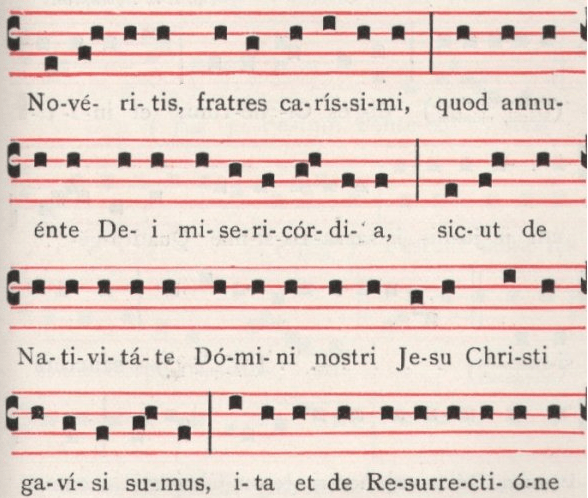
The Noveritis, also known as the Epiphany Proclamation, is a listing of liturgical dates of moveable feasts in the year ahead. Noveritis is the first word of a refrain when the text is sung.
According to ancient custom, the date of Easter was announced on the feast of Epiphany. This tradition dated from a time when calendars were not readily available, and the church needed to publicize the date of Easter, since many celebrations of the liturgical year depend on it. (Wikipedia)
The proclamation may be read or sung, either after the reading of the Gospel or after the postcommunion prayer.
Dear brothers and sisters, the glory of the Lord is dawning upon us, and will always shine on us until the day of his return.
We will celebrate the mysteries of our salvation in the course of the coming year:
Ash Wednesday will be on the _____ of _____, the beginning of the season of Lent.
We will celebrate Resurrection of our Lord on the _____ of _____, with Easter joy.
The Ascension of our Lord will be on the _____ of _____.
The Day of Pentecost will be on the _____ of _____.
The First Sunday of Advent will be on the _____ of _____.
To Jesus Christ, who is, who was, and who is coming, the Lord of all time and history, be endless praise, forever and ever. Amen.
Dear brothers and sisters, the glory of the Lord is dawning upon us, and will always shine on us until the day of his return.
We will celebrate the mysteries of our salvation in the course of the coming year:
Ash Wednesday will be on the 14th of February, the beginning of the season of Lent.
We will celebrate Resurrection of our Lord on the 31st of March, with Easter joy.
The Ascension of our Lord will be on the 9th of May.
The Day of Pentecost will be on the 19th of May.
The First Sunday of Advent will be on the 1st of December.
To Jesus Christ, who is, who was, and who is coming, the Lord of all time and history, be endless praise, forever and ever. Amen.
For 2025
Dear brothers and sisters, the glory of the Lord is dawning upon us, and will always shine on us until the day of his return.
We will celebrate the mysteries of our salvation in the course of the coming year:
Ash Wednesday will be on the 5th of March, the beginning of the season of Lent.
We will celebrate Resurrection of our Lord on the 20th of April, with Easter joy.
The Ascension of our Lord will be on the 29th of May.
The Day of Pentecost will be on the 8th of June.
The First Sunday of Advent will be on the 30th of November.
To Jesus Christ, who is, who was, and who is coming, the Lord of all time and history, be endless praise, forever and ever. Amen.
For 2026
Dear brothers and sisters, the glory of the Lord is dawning upon us, and will always shine on us until the day of his return.
We will celebrate the mysteries of our salvation in the course of the coming year:
Ash Wednesday will be on the 18th of February, the beginning of the season of Lent.
We will celebrate Resurrection of our Lord on the 5th of April, with Easter joy.
The Ascension of our Lord will be on the 14th of May.
The Day of Pentecost will be on the 24th of May.
The First Sunday of Advent will be on the 29th of November.
To Jesus Christ, who is, who was, and who is coming, the Lord of all time and history, be endless praise, forever and ever. Amen.
A shorter form, based on the Latin text:
Dear brothers and sisters, as we have rejoiced in the birth of our Lord Jesus Christ, so by God’s mercy we announce to you the joy of our Savior’s resurrection.
Ash Wednesday, the beginning of Lent, will occur on the _____ of _____.
The Resurrection of our Lord will occur on the _____ of _____.
The Ascension of the Lord will be commemorated on the _____ of _____.
Pentecost, the conclusion of the season of Easter, will be celebrated on the _____ of _____.
Thus the First Sunday of the Advent of our Lord Jesus Christ will be the _____ of _____.


 A Collection of Prayers