directs to our index/contents page. (Tip: Put a link from this page on your computer or phone’s desktop, and you will always have access to a virtual prayerbook!)
This lorica (breastplate) prayer is called “Alexander’s Breastplate” because it is between two poems about Alexander the Great in the Welsh Book of Taliesin.
On the face of the earth his equal was not born, Three persons of God, one gentle Son in the glorious Trinity. Son of the Godhead, Son of the Manhood, one wonderful Son. Son of God, a fortress, Son of the blessed Mary, Son, Servant, Lord. Great his destiny, great God supreme, in heavenly glory. Of the race of Adam and Abraham, and of the line of David, the eloquent psalmist, was he born. By a word he healed the blind and deaf from every ailment; the gluttonous, vain iniquitous, vile, perverse, to rise toward the Trinity by their redemption. The Cross of Christ is our shining breastplate against every ailment. Against every hardship may it certainly be our city of refuge.
Source: Book of Taliesin, Welsh, 10th-14th Century, excerpt The Four Ancient Books of Wales, 1868, p. 557-558.
Source of this version: Prayers from the Ancient Celtic Church.
Original in Old Welsh:
Ar clawr eluyd y gystedlyd ny ryanet. Teir person duw. vn mab adwyn terwyn trinet. Mab yr dwydit. mab yr dyndit. vn mab ryued. Mab duw dinas. mab gwen meirgwas. mat gwas gwelet. O hil ade ac abrahae yn ryanet. O hil dofyd dogyn dwfynwedyd llu ryanet. Dyduc o eir deill abydeir o pop aelet. Pobyl ginhiawc. goec gamwedawc salw amnyned. Rydrychafom erbyn trindawt gwedy gwaret. Croes cristyn glaer. lluryc llachar rac pop aelat. Rac pop anuaws poet yn dilis dinas diffret.
Let us pray, brothers, to the Lord our God for our brother _____, who now suffers under severe hardships, that the goodness of the Lord may heal him with heavenly medicine. May he who has given the soul, also preserve it; through our Lord. [1]
To the almighty living God, who restores and strengthens all his works, let us pray, dear brothers, for our sick brother, that either in renewal or recovery the creature may feel the hand of the creator; in the man of his making may the tender Father recreate his work; through our Lord. [2]
O Lord, holy Father, author of the universe, almighty and eternal God, to whom all are alive. You bring the dead to life and call things that are not as those that are. Since you are the maker, in love do your work for this person you have fashioned; through our Lord. [3]
To God, in whose hands are the support of the living and the life of the dead, we pray that this infirm body may be cured and this soul be healed, that what he does not deserve by merit, he may receive by our prayers for your mercy’s sake; through our Lord. [4]
O God, you do not desire the death of a sinner but that he turn and live. Forgive the sins of this man who has turned to you with all his heart, and give him the grace of eternal life; through our Lord. [5]
O God, you always govern your creatures with tender affection. Hear our prayers for your servant _____, who is suffering from bodily sickness. Visit him with your deliverance, and give him the medicine of your heavenly grace; through our Lord. [6]
Source: The Book of Dimma, 7th century. Prayer #6 is also found in Gelasian sources.
Oremus, fratres, dominum deum nostrum pro fratre nostro .n. quem duri adpresens malum langoris adulcerat, ut eum domini pietas caelestibus dignetur curare medicinis ; qui dedit animam det etsalutem, perdominum nostrum. [1]
Deum uiuum omnipotentem, cui omnia opera restaurare [et] confirmare facillimum est, fratres carissimi, profratre nostro infirmo supliciter oremus, quo creatura manum sentiat creatoris aut inreparando aut inrecipiendo ; inhomine suo pius pater opus suum recreare dignetur, perdominum nostrum. [2]
Domine, sancte pater, uniuersitatis auctor, omnipotens aeternae deus, cui cuncta uiuunt, qui uiuificas mortuos et uocas ea quae non sunt, tanquam ea quae sunt, tuum solitum opus, qui es artifex, pie exerce in hoc plasmate tuo, perdominum. [3]
Deum in cuius manu tam alitus uiuentis quam uita morientis, fratres dilectissimi, deprecemur, ut corporis huius infirmitatem sanet et animae salutem prestet; ut quod per meritum non meretur, misericordiae gratia consequatur, orantibus nobis, perdominum. [4]
Deus, qui non uis mortem peccatoris, sed ut conuertatur et uiuat, huic adte excorde conuerso peccata dimite, et perennis uitae tribu[e] gratiam, perdominum. [5]
Deus, qui facturam tuam pio semper do[mi]nares afectu, inclina aurem tuam suplicantibus nobis tibi; ad famulum tuum .n. aduersitate ualitudinis corporis laborantem placitus respice; uisita eum insalutare tuo, et caelestis gratiae ad medicamentum, per dominum. [6]
Deus meus adiuva me, [My God, help me.]
Give me your love, O Son of God,
Give me your love, O Son of God, Deus meus adiuva me.
In meum cor, ut sanum sit, [Into my heart, that it may be sound,]
O noble King, give your love quickly,
O noble King, give your love quickly, In meum cor, ut sanum sit.
Domine da quod peto a te, [O Lord, give what I ask of you,]
Give, give quickly, O clear, bright sun,
Give, give quickly, O clear, bright sun, Domine da quod peto a te.
Hanc spero rem et quaero quam, [This thing I hope for, and this is what I ask,]
Your love to me in this world,
Your love to me in the next world, Hanc spero rem et quaero quam.
Tuum amorem, sicut vis, [Your love, as you wish,]
Give me quickly what I ask again,
Give me quickly what I ask again, Tuum amorem, sicut vis.
Quaero, postulo, peto a te, [I search, I ask, I beg of you,]
My life in heaven, Son of God,
My life in heaven, Son of God, Quaero, postulo, peto a te.
Domine, Domine, exaudi me, [O Lord, O Lord, hear me,]
Fill my soul with your love, O God,
Fill my soul with your love, O God, Domine, Domine exaudi me.
Deus meus adiuva me, Deus meus adiuva me.
Source: Mael Ísu Ua Brolcháin, d. 1086 The Poem-Book of the Gael, 1912, p. 140-141, translation composite.
O God,
you know my weakness.
I am poor and destitute.
I cannot do or think anything good without you.
Help and strengthen me with your grace,
that I may resolve
not only to avoid the evil you forbid,
but also to do the good you command. Amen.
Source: The Irish Handbook of the Holy League, called the Apostleship of Prayer, Dublin, 1890, p. 56
Original in traditional English:
Thou knowest, O God, my weakness; that I am poor and destitute; that I cannot do, nor even think of any good without Thee; arise, then, up to help me; strengthen me with Thy grace, that I may fervently execute what I have firmly resolved, and not only avoid all the evil Thou forbiddest, but also perform all the good Thou commandest. Amen.
This litany from an Irish prayer book asks Jesus for mercy appealing to who he is, his attributes, his virtue, his love and his work. A shorter Litany on the Name of Jesus is found at Litany (Name of Jesus).
Lord, have mercy. Christ, have mercy. Lord, have mercy. Christ, have mercy.
Jesus, hear us. Jesus, graciously hear us.
God the Father of heaven, have mercy. God the Son, Redeemer of the world, have mercy. God the Holy Spirit, have mercy.
Holy Trinity, one God, have mercy.
Jesus, Son of the living God,
Jesus, Splendor of the Father,
Jesus, Brightness of eternal light,
Jesus, King of glory,
Jesus, Sun of justice,
Jesus, Son of the virgin Mary, have mercy on us.
Jesus most lovable,
Jesus, most adorable,
Jesus, most admirable,
Jesus, the mighty God,
Jesus, Father of the world to come,
Jesus, Angel of great counsel,
Jesus, most powerful,
Jesus, most patient,
Jesus, most obedient.
Jesus, meek and humble of heart, have mercy on us.
Jesus, Lover of chastity,
Jesus, Lover of us,
Jesus, God of peace,
Jesus, Author of life,
Jesus, example of all virtues,
Jesus, zealous Lover of souls,
Jesus, our God,
Jesus, our Refuge,
Jesus, Father of the poor,
Jesus, Treasure of the faithful, have mercy on us.
Jesus, Good Shepherd,
Jesus, True Light,
Jesus, Eternal Wisdom,
Jesus, Infinite Goodness,
Jesus, the Way, the Truth, and the Life,
Jesus, Joy of angels,
Jesus, Master of apostles,
Jesus, Teacher of evangelists,
Jesus, Strength of martyrs,
Jesus, Light of confessors,
Jesus, Purity of virgins,
Jesus, Crown of all saints, have mercy on us.
Be merciful to us: Spare us, O Jesus,
Be merciful to us: Hear us, O Jesus.
From all evil,
From all sin,
From your wrath,
From the snares of the devil,
From the spirit of fornication,
From everlasting death,
From neglect of your holy inspirations, Lord Jesus, deliver us.
Through the mystery of your holy Incarnation,
through your nativity,
through your divine infancy,
through your sacred life,
through your labors,
through your agony and passion,
through your cross and dereliction,
through your pains and torments,
through your death and burial,
through your glorious resurrection,
through your ascension,
through your joys and glory,
in the day of judgment, Lord Jesus, deliver us.
Lamb of God, you take away the sins of the world: Spare us, Lord Jesus. Lamb of God, you take away the sins of the world: Hear us, Lord Jesus. Lamb of God, you take away the sins of the world: Have mercy on us, Lord Jesus.
V. May the name of the Lord be praised. R.Now and forever.
Let us pray.
O Lord Jesus Christ, you said, “Ask, and it will be given to you; seek, and you will find; knock, and it will be opened to you.” Mercifully hear our prayers and give us your gift of divine charity, that we may always love you with all our heart, and always praise your holy name; for you live and reign, one God, now and forever. Amen.
Source: Modified from The Irish Handbook of the Holy League, called the Apostleship of Prayer, Dublin, 1890, p. 59-62
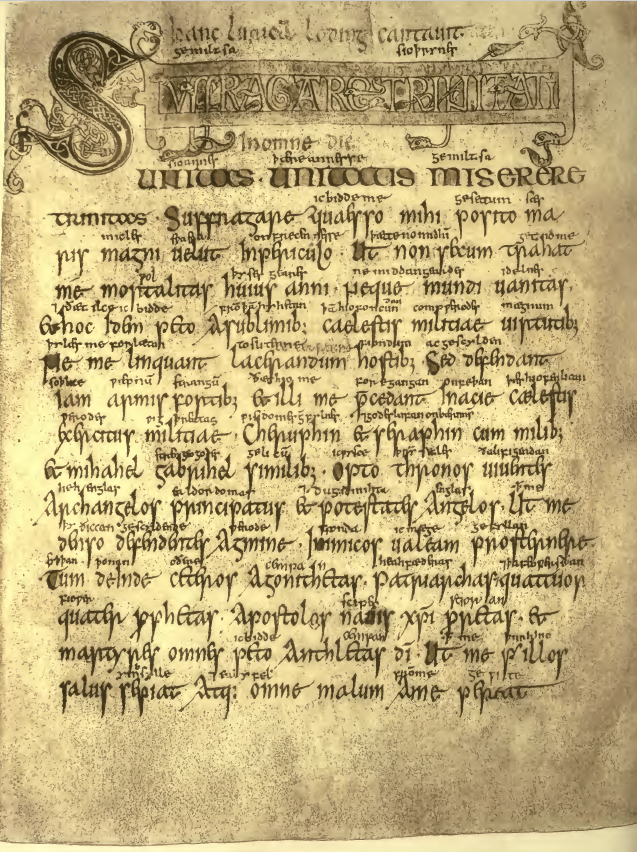
The Lorica of St. Fursey begins in the right column, by the capital R.
May the guiding hands of God be on my shoulders,
may the presence of the Holy Spirit be on my head,
may the sign of Christ be on my forehead,
may the voice of the Holy Spirit be in my ears,
may the smell of the Holy Spirit be in my nose,
may the sight of the company of heaven be in my eyes,
may the speech of the company of heaven be in my mouth,
may the work of the church of God be in my hands,
may the serving of God and my neighbor be in my feet,
may God make my heart his home,
and may I belong to God, my Father, completely.
Source: Lorica of St. Fursa (Fursey), 7th Century.
Robé mainrechta Dé forsind [f]ormna-sa,
robé torruma in spirta naoimh for in cend-sa,
robé airde Críst isin édan-sa,
robé ésdecht in spirta náimh isna clúasaib-sea,
robé bolltanugad in spirta nóib isna srónaib-sea,
robé imfaiccsin fer nime isna súilib-sea,
robé comlabra fer nime isna bélaib-sea,
robé lubair eculsa Dé isna lámaib-sea,
robé les Dé ocus a choimnesa isna cosaib-sea,
roba locc do Día in cride-sea,
rob la Día athair uile in duine-sea!
The Lorica (Breastplate) of Gildas is also known as the Lorica of Loding, and is found in the Book of Cerne.
Trinity in unity, preserve me.
Unity in Trinity, have mercy on me.
I pray,
preserve me from all dangers
which overwhelm me
like the waves of the sea,
so that neither mortality
nor the vanity of the world
may sweep me away this year.
And I also ask,
send the high, mighty hosts of heaven,
that they not abandon me
to be destroyed by enemies,
but defend me now
with their strong shields
and that the heavenly army
advance before me:
cherubim and seraphim by the thousands,
and archangels Michael and Gabriel, likewise,
I ask, send these living thrones,
principalities and powers and angels,
so that I may be strong,
defended against the flood of strong enemies
in the next battle.
May Christ, whose terror scares away the foul throngs,
make with me a strong covenant.
God the unconquerable guardian,
defend me on every side by your power.
Free all my limbs,
with your safe shield protecting each,
so that the fallen demons cannot attack
against my sides or pierce me with their darts.
I pray, Lord Jesus Christ, be my sure armor.
Cover me, therefore, O God, with your strong breastplate.
Cover me all in all with my five senses,
so that, from my soles to the top of the head,
in no member, without within, may I be sick;
that, from my body, life be not cast out
by plague, fever, weakness, suffering,
Until, with the gift of old age from God,
departing from the flesh, be free from stain,
and be able to fly to the heights,
and, by the mercy of God, be borne in joy
to the heavenly cool retreats of his kingdom.
Source: The Lorica of Gildas, also known as the Lorica of Loding from the Book of Cerne.
Note: The Lorica of Loding continues after the section above to appeal to the saints for protection, and then to pray, individually, for protection for all the parts of the body. The remainder of the Lorica is presented below, based on the translation by Hugh Williams in Gildas: The Ruin of Britain … together with the Lorica of Gildas, 1899.
Patriarchs four, prophets four,
apostles, watchmen of the ship of Christ,
and all the athlete martyrs, I ask–
And charge also all virgins,
faithful widows, and confessors,
to surround me by their safety,
and every evil perish from me.
May Christ, whose terror scares away the foul throngs,
make with me a strong covenant.
God the unconquerable guardian,
defend me on every side by your power.
Free all my limbs,
with your safe shield protecting each,
so that the fallen demons cannot attack
against my sides, or pierce me with their darts.
Skull, head, hair and eyes,
forehead, tongue, teeth and their covering,
neck, breast, side, bowels,
waist, buttocks and both hands.
For the crown of my head with its hair,
be the helmet of salvation on my head;
for forehead, eyes, triform brain,
nose, lip, face, temple;
for chin, beard, eye-brows, ears,
cheeks, lower cheeks, internasal, nostrils;
for the pupils, irises, eyelashes, eyelids,
chin, breathing, cheeks, jaws;
for teeth, tongue, mouth, throat,
uvula, windpipe, bottom of tongue, nape;
for the middle of the head, for cartilage,
neck—you, kind One, be near for defense.
I pray, Lord Jesus Christ, by the nine orders of holy angels,
Lord, be my sure armor,
for my limbs, for my entrails,
that you may drive back from me the invisible
nails of stakes, which enemies fashion.
Cover me, therefore, O God, with strong breastplate,
along with shoulder blades, shoulders and arms.
Cover my elbows and elbow-joints and hands,
fists, palms, fingers with their nails.
Cover back-bone and ribs with their joints,
hind-parts, back, nerves and bones.
Cover surface, blood and kidneys,
haunches, buttocks with the thighs.
Cover hams, calves, thighs,
knee-caps, hocks and knees.
Cover ankles, shins and heels,
legs, feet with the rests of the soles.
Cover the branches that grow ten together,
with the toes and their nails ten.
Cover chest, sternum, the little breast,
nipple, stomach, navel.
Cover belly, reins, genitals,
and paunch, and vital parts also of the heart.
Cover the triangular liver and fat,
spleen, armpits with covering.
Cover stomach, chest with the lungs,
veins, sinews, gall-bladder with
Cover flesh, groin with the inner parts,
spleen with the winding intestines.
Cover bladder, fat and all
the numberless orders of joints.
Cover hairs, and the rest of my limbs,
whose names, may be, I have passed by.
Cover me all in all with my five senses,
and with the ten doors formed for me,
so that, from my soles to the top of the head,
in no member, without within, may I be sick;
that, from my body, life be not cast out
by plague, fever, weakness, suffering,
Until, with the gift of old age from God,
I blot out my sins with good works;
And, in departing from the flesh, be free from stain,
and be able to fly to the heights,
and, by the mercy of God, be borne in joy
to the heavenly cool retreats of his kingdom.
O Holy Spirit, hasten to us!
Move round about us, in us, through us!
All our deadened souls’ desires
Inflame anew with heavenly fires!
Yea ! let each heart become a hostel
Of your bright presence Pentecostal,
Whose power from pestilence and slaughter
Shall shield us still by land and water.
From bosom sins, seducing devils,
From hell with all its thousand evils,
For Jesus’ only sake and merit,
Preserve us, O Almighty Spirit!
found in A Celtic Psaltery, by Alfred Perceval Graves, F. A. Stokes Company, New York, 1917.





 A Collection of Prayers